By the time I woke up Wednesday morning, every one of my news feeds had rushed to declare the election for Trump. Sure, democrats underperformed (we’ll have plenty of time to discuss why). As of now, though, just glancing at the 2020 election results, something like fifteen million votes have yet to be counted. There’s no electoral mandate. We don’t even know the popular vote yet. So why the rush to conclusions and concessions?
Consider how insane one would sound explaining this to an outside observer—Oh no! Kamala lost! So Trump won the vote? Actually we don’t know yet. Ok? But, but, Kamala lost the Electoral College. Is that one of those guardrails that ensure majority rulemaking? No, it was just a pro-slavery concession. Well is the College perhaps a better way of divining the majority will? No, recently, it regularly rules in favor of minority-vote presidents. Okay, so what grants this College legitimacy? Because it’s written down in the Constitution. Oh. What else does the Constitution say about the Electoral College? Well Section 2 of the Fourteenth Amendment does say that States should be stripped of representation in proportion to their suppression of eligible voters. When do you have to do that by? January 6 or so. Have you canvassed voter suppression policies to rebalance Electoral Votes yet? No. Plan to? Uhhhh . . . Okay . . . And also, since Section 2 only generally mentions “representation” and not the College specifically, it’s doubtful the slave-power roots of the College would survive mature reads of the either the Thirteenth Amendment or the Fourteenth Amendment’s guarantee of equal citizenship. Wow . . . any others? Yeah . . . and the Fifteenth Amendment just says States don’t get to engage in racialized voter suppression, implying a more categorical prohibition and punishment than mere proportional representation stripping. Same deadline? Yep. Started yet? Nope. [exasperation] What else? Um . . . well . . . Section 3 of the Fourteenth Amendment pretty clearly disqualifies Trump from office. Really? “No person shall . . . hold any office, civil or military, under the United States . . . who, having previously taken an oath . . . as an officer of the United States . . . to support the Constitution of the United States, shall have engaged in insurrection or rebellion against the same.” January 6? Yes, and yes. So you’re going to follow the numerous provisions that reject this insane Electoral College thing? What? No. We already conceded.—What collective psychosis drives us to pick and choose the rules to lose by? Do we prefer self-righteousness in defeat to the responsibility of victory?
But, I hear the voices clamor, custom and tradition point us to the Electoral College over the popular vote. Utterly false. Twenty four years of Democratic Party defeat-fetishism—predicated on one of the stupidest Supreme Court decisions of our nation’s brief and sorry history—tells you to follow the Electoral College over the popular vote. Before that? Clinton ’92: won the popular vote. Bush ’88: won the popular vote. Reagan ’80: popular vote. Carter ’76: popular vote. Nixon ’68: tight, but popular vote. Johnson ’64: popular vote. Kennedy ’60: tight, but popular vote. Eisenhower ’52: popular vote. Truman ’48: popular vote. Roosevelt ’32: popular vote. Hoover ’28: popular vote. Coolidge ’24: popular vote. Harding ’20: popular vote. Wilson ’12: popular vote. Taft ’08: popular vote. Roosevelt ’04: popular vote. And, hell, let’s keep going. McKinley ’96: popular vote. Cleveland ’92: popular vote. We have to go back to Benjamin Harrison’s election in 1888 to reach the last time a candidate won the popular vote and the nation said: sure, whatever, give it to the other guy. And it’s pretty hard to call that election a shining beacon of democracy when black men and all women couldn’t vote. When you toss the popular vote for the Electoral College, you’re bending over backward for a “tradition” that can’t even rent a goddam car.
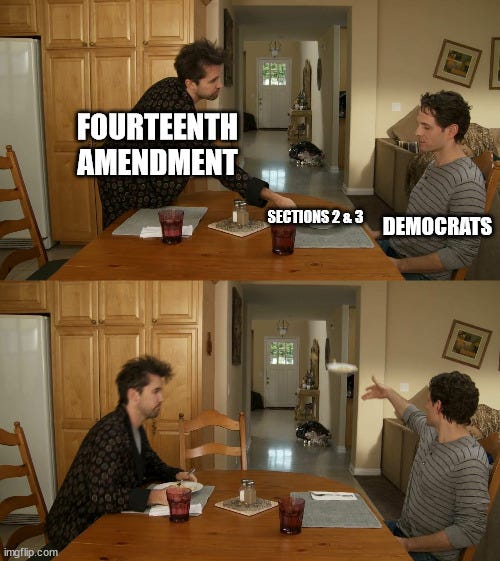
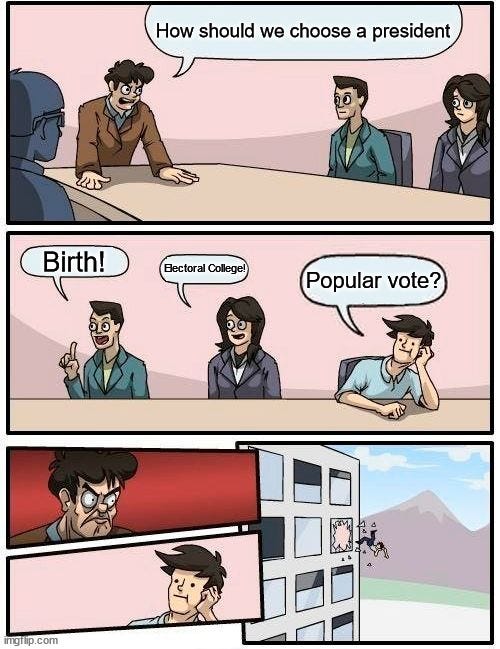
The first rule in democratic decisionmaking is to ask which candidate or measure won the popular vote. There may be practical reasons to demand supermajorities for some measures (though I tend to doubt it). But there’s got to be a good reason to just ignore a majority vote. Lincoln thought the incompatibility of slavery and democracy was one of those reasons—though, ironically, he ran for office on it. The Electoral College isn’t one of those reasons. It has no inherent moral validity. Honestly, it doesn’t even have any pragmatic validity. NATO isn’t going to invade to enforce the Electoral College. More realistically, we’d cite another unsuspecting nation’s adoption of similar procedure as casus belli to gallivant off in search of oil or lithium or copper. Right now, the only thing that can be said for the Electoral College is that it’s written down in a deeply-flawed document whose most important amendments vary between heavily amending to scrapping it entirely and which also quite clearly disqualify the “victorious” candidate from the office. If our concept of democracy so casually abandons genuine majority rule for unquestioning adherence to the last line we plucked without context from an old rule book, I guess that’s fine. But then don’t tell me “democracy is on the line.” Nothing of the sort.