

In my experience, Brown v. Board and Loving v. Virginia get short-shrift in law school. To the gung-ho, 25 year-old social justice warrior, the Supreme Court’s rejection of segregated schools in Brown offers no more than a half-assed repudiation of Plessy v. Ferguson (“separate but equal”). And instead of grappling with lawmakers’ racial animus (hostility) underlying “separate but equal,” Brown instead relies on sociological data about kids’ “feelings.” But at least Brown prompted some, however “deliberate” and plodding, action. Twelve years later, when Loving recognized a right to interracial marriage, the Court struck down antimiscegenation laws in, what, the sixteen States where they remained. Less meaningful movement toward racial equity and more just jumping on the bandwagon.
I’ll admit to lazily adopting these takes about Brown and Loving for the last several years. To be sure, I did at least think that Loving shows us a thoughtful and more rigorous approach to individual rights than the usual liberal, history and living tradition method. But I’ve certainly given short shrift to what Brown and Loving teach about equal protection more generally. I now suggest two reasons. On one hand, Brown and Loving succeeded so fully that we cannot really imagine anymore life before them. On the other, later decisions of the Court have taken us so far from Brown and Loving that it’s easier and less painful to pretend there never really was any there there in the first place.
To illustrate the sea change, it’s worth stepping back to an earlier keystone race-discrimination case that I suspect we’ve also been misreading. On its face, Korematsu—when the Supreme Court blessed the rounding up into concentration camps of west-coast Japanese Americans—stands for two propositions: 1) while racial classifications get “strict scrutiny” (quoth Hugo, “all legal restrictions which curtail the civil rights of a single racial group are immediately suspect . . . courts must subject them to the most rigid scrutiny”); 2) often enough, “national security” gets trotted out to justify racism and violation of rights. Obviously Korematsu gets it wrong by our lights; but there’s the rub. We can’t read Korematsu from our perspective; we have to read it from the perspective of the flawed Supreme Court justices learning in real time not only what racial discrimination is but which instances of racial discrimination matter to the Fourteenth Amendment (you know, citizenship, due process, equality)—not to mention learning when the facts make out a plausible case of discrimination.
Recall, “separate but equal” is just the horseshit gloss we put on Plessy to explain Jim Crow segregation. The real legwork in Plessy comes from the Court’s holding that the Fourteenth Amendment does not apply to “social” issues (just as the Civil Rights Cases said about the Thirteenth). That is, the Reconstruction Amendments simply do not care about most instances of racial discrimination. So, as I asked my pre-law students a few weeks back, what case would you cite in Mr. Korematsu’s defense? Strauder v. West Virginia? Can’t exclude Black men from juries. A specific, long-recognized (and enumerated by Civil Rights Act of 1866) issue relating to niche issues of local self-government. Wong Kim Ark? Children born to Asian-American immigrants are citizens? Great, but the Court also accepted without question that Congress could limit the admission of or just totally bar Asian immigrants.
Yick Wo. v. Hopkins? Sure, there the Court recognized that the Equal Protection Clause applied where the City of San Francisco granted nearly all white-applicant laundry building permits and denied all Chinese-American applicants. That is, disparate application of a facially-neutral law could violate equal protection. But that lofty legal recognition runs headlong into a thorny factual question: when lawmakers learn to whisper their racial biases behind closed doors and off the record, we do we have enough proof to conclude—factually—that a law reflect unlawful racial animus? Yick Wo presented a simple case. The City backed the Court into a corner, offering no explanation at all for the total rejection of Chinese-American applicants. The Court had no choice but to conclude, as a matter of fact, that racial animus . . . well . . . animated the decision. It’s not unfair to read Yick Wo less as woke-SCOTUS and more as “lie better” SCOTUS. And notice that Yick Wo is very much not a case about civil or social equality. It’s a case about letting immigrants do service work.
So put yourself into the world before Brown. What did “equal protection” mean for Americans of color by 1944? As a matter of law, not protection from private action. Not protection within the “social sphere,” that is, most of your daily life. Not protection from matters of State or foreign affairs. And as a matter of fact, not protection from discrimination coming under any other guise or explanation.
On this background then, give the haters their due, Brown and Loving do reconstruct the Constitution. With Brown, the Equal Protection Clause starts to mean something. For one, it cuts through the question of whether the Fourteenth Amendment applies. Segregated schools had been the first example Plessy gave us of an (intensely local) social issue laying beyond the reach of the Fourteenth Amendment. In other words, Brown dispenses with Plessy’s (and Civil Rights Cases) central distinction between the civil and the social. Taken seriously, now the Reconstruction Amendments apply potentially to everything the States might do to you.
For another, Brown cuts through the quagmire of proving racial animus as a matter of fact. Sure, in some light, Brown can be viewed as a mealy-mouthed compromise, Chief Justice Warren gathering a unanimous Court at the expense of avoiding discussion of why the States had been in the habit of segregating the schools on the basis of race (white supremacy). That would have been a nice decision. But don’t let that obscure what we got instead:
Segregation of white and colored children in public schools has a detrimental effect upon the colored children. The impact is greater when it has the sanction of the law, for the policy of separating the races is usually interpreted as denoting the inferiority of the negro group. A sense of inferiority affects the motivation of a child to learn. Segregation with the sanction of law, therefore, has a tendency to [retard] the educational and mental development of negro children and to deprive them of some of the benefits they would receive in a racial[ly] integrated school system.
. . .
Separate educational facilities are inherently unequal.
Whether or not the States intended segregated schools to deprive Black children of equal educational opportunity is irrelevant to the decision. All that matters is that the children got the message. Oh, you State legislator’s didn’t specifically intend this result? You expected it, but didn’t mean it? Or you didn’t even realize it could play out this way. Irrelevant. It does not matter that the States segregated the schools specifically to subordinate on the basis of race—because the Court neither mentions it nor relies on it (and it hardly mentions the segregation laws either, showing how little role they play). The power of Brown rests in its holding that the legislator’s intent (or lack thereof) plays no role; the decision turns entirely on the law’s impact.
And it gets better. If Brown focused on effect, Loving focused on intent. Virginia justified its antimiscegenation laws (besides appealing to white supremacist propriety and tradition) on the basis that it treated (punished) white and black alike. The Court dismissed that argument out of hand (in a line that Chemerinsky omits from his textbook abridgement of Loving, so perhaps it’s not entirely my fault for missing it until recently):
The clear and central purpose of the Fourteenth Amendment was to eliminate all official state sources of invidious racial discrimination in the States.
Not effects, or impact, or harms flowing from invidious discrimination—“sources.” Nothing about a law needing some sort of specific wording, or facial racial classification. Intent, racial animus, alone damns a law. Chief Justice Warren makes this even clearer a few paragraphs later, explaining an alternate approach whenever laws differentiated on the basis of race: that “[a]t the very least, the Equal Protection Clause demands that racial classifications . . . be subjected to the most rigid scrutiny.” This, of course, makes sense. The men who had spent the last twelve years demanding racial cognizance for the remedial purpose of integrating schools would necessarily approach bare racial-classifications and racial animus differently. The take-home point still stands though. Explicit or not, laws driven by racial animus could never stand.
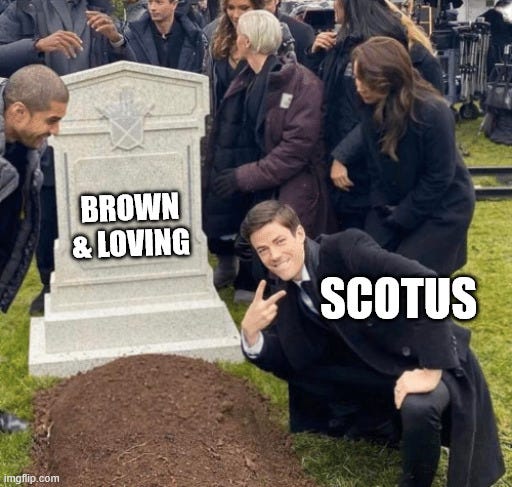
If the one-two punch of Brown and Loving—that the Fourteenth Amendment proscribes both 1) racialized impact regardless of intent and 2) racial animus regardless of effect—seems like news to you, it’s not your fault. The moment Chief Justice Warren retired, the Supreme Court got to work pulling back from the joint-promise of Brown and Loving.
In 1971’s Palmer v. Thompson, the Court upheld Jackson’s (Mississippi) decision to close the city pools instead of integrate them. Allegations of racial animus, without disparate impact, Hugo told us, didn’t trigger heightened scrutiny. The other shoe dropped only five years later. Racial disparity without allegation of intent, Byron told us in Washington v. Davis, didn’t trigger heightened scrutiny either. Simply put, racial animus or disparity, each alone sufficient under Brown and Loving to damn a law, no longer warranted a court’s second glance unless accompanied by the other, so long as the law didn’t expressly mention race on its face—as though Brown and Loving would suffer such formalism. Palmer and Davis should not be read, as many law professors now pretend, to clarify some needed distinction between facial and non-facial racial classifications. They substantially overrule Brown and Loving.
And the Court buried them further, upping the required level of intent required alongside a disparate impact. In 1977’s Village of Arlington Heights v. Metropolitan Housing Development Corp., the Court demanded racial animus be a “motivating factor.” Two years later in Personnel Administrator v. Feeney, the Court required that animus (this case actually dealt with gender discrimination) be even more plain:
The appellee’s ultimate argument rests on the presumption, common to the criminal and civil law, that a person intends the natural and foreseeable consequences of his voluntary action.
. . .
“Discriminatory purpose,” however, implies more than intent as volition or intent as awareness of consequences. It implies that the decisionmaker, in this case a state legislature, selected or reaffirmed a particular course of action at least in part “because of,” not merely “in spite of,” its adverse effects upon an identifiable group.
Simply put, so long as a state legislature acted—on the record of 400 years of human chattel bondage—with no more than the knowledge that its actions would disproportionately impact Americans of color, it could avoid judicial scrutiny by simply employing race-neutral enough language.
This post has gone on long enough. So suffice it say the Supreme Court laid the groundwork for Trump v. Hawaii, upholding the Muslim-Travel Ban on “national security” grounds because it didn’t actually say “Muslim,” long ago. But saying things suck today because they’ve always sucked and were always going to suck is cheap and lazy. It’s also just wrong. Brown and Loving had us on the right track. We’ve let ourselves forget how right they were. Can’t blame the Founders for this one folks.
A real education: so much has been lost since Brown v Board and Loving v VA. Bobby makes the case plainly and irrefutably. This article deserves to be read.