

Edmund Burke never actually said, “The only thing necessary for the triumph of evil is for good men to do nothing.” But, you know, I would have been willing to give him this one. The notion offers great comfort and aid to those rallying bystanders against a perceived foe. Of course, as a theory of history, the line proves more exculpatory than accurate. Oh! We misapprehended—Pawns of history. Distracted and fooled we were. If only we’d known the threat! Except, all too often, we did. No one stood around twiddling thumbs during Secession. White Southerners voted for it. No one stood aside to let Hitler take power. Fearing actual socialism, the German middle chose National Socialism. As between the abolition of private property and promised genocide, professed liberals chose death.
Until somewhat recently, a gracious observer could, with effort, still place the American Catholic Church in Burke’s camp. Just. Between one party dedicated to multiracial democracy and one clamoring to strip voting rights, end affirmative action, and defend racialized police violence; between one party defending immigrants and the other calling them rapists and murderers fit only for cages and mass deportation; between one party taking climate change seriously and the other putting all its efforts into the ballooning military budget; between one party defending labor rights and social welfare and the other gutting firearms regulations before children’s bodies cooled—priests and bishops hemmed and hawed (we don’t take positions . . . vote your conscience) all while preaching the fire and brimstone threat of abortion! Good men, perhaps, doing nothing against the party of war, poverty, and white supremacy.
Good-faith sideliners no more. This past month, Word on Fire, pulpit of America’s most prominent Catholic evangelist, Bishop Robert Barron, published its quarterly Evangelization & Culture magazine on the topic of: democracy. However artfully presented, the issue’s purposes are clear: 1) to undermine faith in democracy; 2) to pave the way for Christian (Catholic) Nationalism; and 3) to assuage the consciences of its Trump-voting readers. One hundred fifty three pages as unreflective as they were unintelligent. And, for my sins, I read damn near every word.
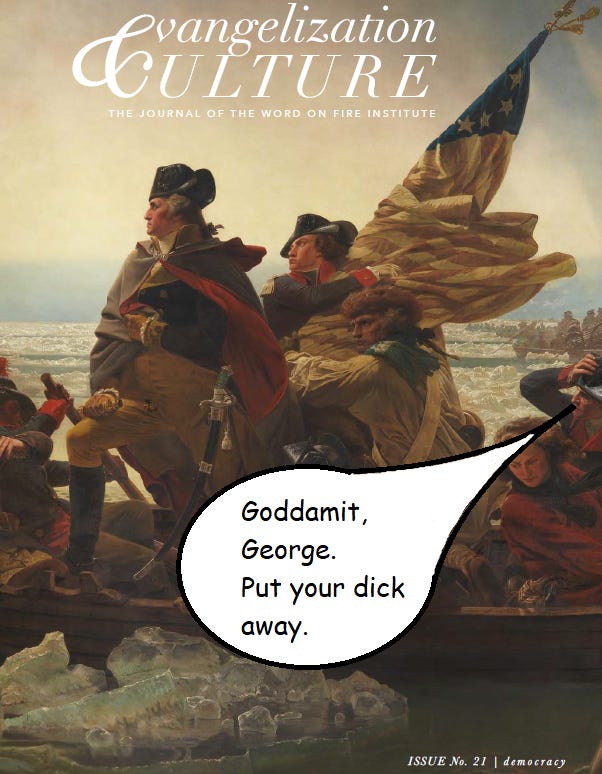
There’s a lot to unpack over the next few posts. Today I’ll start with Word on Fire’s simplistic, dictionary definition of democracy.
Barron & Co. might try to hide the ball, but credit where it’s due, they don’t delay it. Underneath the platitudes (“Catholicism not only supports democracy. It is, in fact, democracy’s greatest friend.”) (3), Word on Fire Institute Director Dr. Matthew Petrusek introduces the volume’s shallow, dictionary concept of democracy: “power to the people”—dismissing the form of governance as a mere “procedural system” prone to transform “naked self-interest” into “majoritarian domination,” lacking “any moral validity at all” unless “grounded in pre-democratic values that exist prior to, and out of the reach of, voters’ whims” (3). Dr. Tod Worner, the magazine’s managing editor, adds that “democracy occasionally yields a well-honed product,” before charging (without offering specifics) that American democracy has “devolved to a point where a bill serving almost any [really?] interest or appetite (no matter how heinous) can be passed into law without dispute [again, really?] if there are enough votes and an abstaining [paging E. Burke on line 3] veto pen” (7, 9) (let’s try to ignore him pegging the “horror of” “the Nazi experiment” on “democracy gone wrong” while lauding the adolescent Weimar Republic as “a modern, sophisticated democracy”) (5–6).
In a transcribed conversation with Worner, Bishop Barron echoes the simplistic dictionary definition before contributing two jabs of his own. First, Barron attributes the Civil War to an inherent flaw in democracy:
Because say what you want about the Civil War, one thing it meant was that the democratic system fell apart . . . .
[I]f the Founders were such geniuses and our system so good, why did it fall apart tragically and catastrophically.
(39, 41) (I don’t have time to deal with this here. Go read my essay on the Lincoln-Douglas Debates). Second, bookending a good natured (and dare one say, relativist?) recounting of democracy’s skeptics, Barron begins and ends with overt denunciations:
And everyone knows Churchill’s famous quote: “Democracy is the worst form of government except for all those other forms that have been tried from time to time.” With typical Churchillian wit, he starts with the recognition that democracy is a limited, deeply problematic system.
In Rome, you had some very bright people who never thought what we’re calling liberal democracy was a good idea. And the same is true around the world today . . . Democracy as we’re describing it would strike them as a very bad idea . . . .
In sum, for all kinds of reasons, people—ancient, medieval, modern, contemporary—have said, “I’m not so sure about democracy. Does it really work?” I don’t want to be entirely dismissive of the half of the world that doesn’t quite see things this way, even as I remain, like Churchill and Lincoln, a singer of the song of democracy. It does have a shadow side.
(41) (and let’s try also to set aside Barron ranking John C. Calhoun, principal ghoul of American Slavery, among America’s “greatest statesmen”) (39).
The primary assault, however, comes from Worner’s misapprehension of Jaffa’s Crisis of the House Divided (and you all thought we were past him!). He distills the argument against slavery thus, “Without making an appeal to my Catholic faith, Lincoln made a brilliant case: majoritarian rule and legal positivism were solidly rebutted by a moral acknowledgement with religious roots found in a Founding document [the Declaration]” (9). The gist cannot be mistaken. Democracy, as a purely procedural device of counting votes, holds no inherent moral value, rarely accomplishes just results, and depends utterly on one’s a priori moral agenda for its validity. That is, democracy is fine, so long as it reaches my preferred outcome.
Barron & Co. ignore democracy’s fundamental justice. Man’s natural moral equality (whether rooted in a vague “Creator” or in the Catholic “God” as Barron puts it) (1, 36) implies political equality: no man is good enough to rule another without their consent. Alone among forms of human government, democracy rests on that consent, manifest in the popular will. Monarchy and aristocracy are not merely impractical for the difficulty of identifying the philosopher king or the best men. Rather, they (just as slavery does) deny the need for any consent of the governed. Or, as Barron should but fails to recognize, they commit the sin of hubris by seeking to rule man as God does. Democracy is no mere procedure for majority rule—by its recognition of human equality, it is both the only legitimate form of human governance and an incarnation of justice toward which we ought to aspire.
This is not to say that the majority will should always prevail. Clearly, from the above, democracy must have substantive guardrails. But the principles whose validity do not depend on the popular will are precisely those which impart moral value to the popular will: primarily, the equal human dignity and purposive capacity which enable democracy in the first instance. Only the unreflective mind contrives the arrogance to place its moral agenda beyond communal reproach. Put differently, the popular will carries moral weight because man has devised no better method for decisionmaking than the messy debate and compromise of communal deliberation. (Don’t just take it from me. Justice Robert Jackson famously concluded his concurrence in Youngstown Sheet & Tube v. Sawyer, “With all its defects, delays and inconveniences, men have discovered no technique for long preserving free government except that the Executive be under the law, and that the law be made by parliamentary deliberations.” 343 U.S. 579 (1952)).
More to come.
Bobby cuts right to the core misconception of this beautifully printed but terribly mistaken issue of Evangelizing the Culture. As he says, the authors at least admit up front that democracy only works for them if it serves a higher non- democratic value. That’s old-school Catholic political phil, fair enough. But after a 20th Century which brought us such “higher” aspirants as Lenin on the left and Franco on the right, how can we keep spouting the same old stuff? Sorry, I’ll take the my chances with the “whims” of the democratic majority any day. An excellent article, with more promised.