

Last time we discussed Word on Fire’s childish concept of democracy. That has consequences!
Barron’s assault on the fundamental justice of democracy manifests in three practical points. First, naturally, he seeks to place the Church’s moral agenda beyond democratic reproach.
Democracies . . . are rooted in certain conditions that are not themselves the object of deliberation. They are founded in moral absolutes—among which are liberty, equality, inviolability of life [you catch it?], and the right to pursue happiness. And these nonnegotiable truths are in turn logically correlative to a belief in a Creator God.
Take out of consideration the Creator. . . and individuals become, in very short order, the objects of political manipulation and domination.
(1). Petrusek roots his three “pre-democratic” values, human dignity, human equality, and the common good, in “Catholic social thought” (3). As above, Worner says that the Church’s moral teaching “solidly rebut[s]” “majoritarian rule and legal positivism” (9). And Tom Hoopes, in a piece primarily dedicated to undermining faith in politics, praises John Paul II’s words, “[T]he Declaration of Independence, the Constitution, the Bill of Rights . . . are grounded in and embody unchanging principles of the natural law whose permanent truth and validity can be known by human reason, for it is the law written by God in human hearts” (54). In fact, by proclaiming the Church’s moral teachings among the otherwise undefined principles antecedent to democratic lawmaking, each of these writers also place Church teaching above deliberation—communal determination of whether these teachings do actually manifest the prodemocratic principle of equal human dignity.
No wonder, despite several pointed hints, the Bishop does not actually explain how the principles embodied in the Declaration prohibit abortion. So much for democracy. American Catholics deserve an explanation of how the principle of women’s natural moral and political equality, dignity, and “capacity for self-rule” vests neither in the women herself, nor in the woman in deliberation with her partner, doctor, and closest confidants and advisors (perhaps including, God-willing, a sensible priest), but rather in a second-rate hack (more commonly called a “district attorney”) the authority to decide when and whether the woman’s personal and familial health, happiness, and wellbeing justify the termination of a pregnancy. American Catholics deserve an explanation how that equal dignity compels women to bleed out in parking lots across the nation, fearful doctors denying care until death seems sufficiently imminent to satisfy the caprice of some scientifically illiterate judges years on. American Catholics deserve an explanation how that equal dignity happily grants the State the categorical authority to conscript women’s bodies for childrearing. And American Catholics deserve an explanation how denying a woman’s capacity for such constitutive personal decisionmaking does not merely deny her capacity to join in our communal decisionmaking as an equal citizen but more so her basic capacity for personal self-governance as a free person.
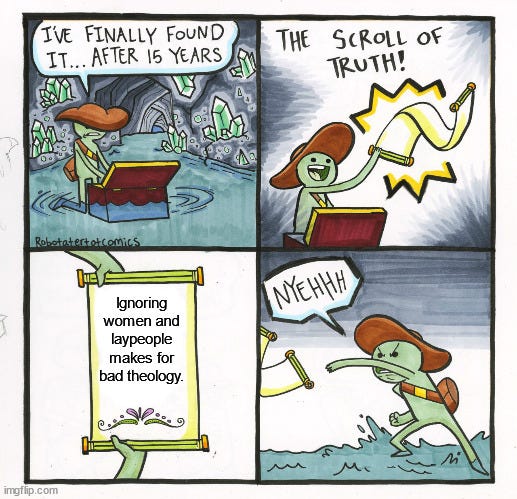
One suspects the omission deliberate—that Barron recognizes the existential threat a mature concept of democracy poses not merely to the Church’s moral teachings but to its constitutional legitimacy. Where is the voice of the laity in the academic circus of unmarried men of varying degrees of unhealthy sexuality? Where is the voice of women? Whatever expertise the clergy brings, such expertise aids deliberation, it does not grant legitimacy to rule over other men, or women! If every other instance of man’s rule of another without his consent constitutes sinful hubris, why should the Church be excepted? If communal deliberation by all the governed comprises the best means of decisionmaking by man, why should the Church’s be special? Divine favor doesn’t really answer. Hubris is hubris. God rules us—not the Church. And more importantly, if the Church wishes to argue Almighty mandate for minority rule without consent, clergy over laity, men over women, then the Church has abandoned any pretense to the proposition that all men are created equal. And if that be so, then the notion that democracy rests on the Church’s moral teachings, or that the Church “is, in fact, democracy’s greatest friend,” is revealed as a would-be tyrant’s lie.
In this installment, Bobby moves from the general to the specific, from critiquing the notion that government-by-consent is only good if it aligns with a higher truth to the more specific issue of abortion law and the equality of women. One can disagree on that point (as do I) but still agree that WOF’s lengthy and fulsomely illustrated number on democracy should at least have addressed abortion, if only as an example, since left and right would agree it is the most pressing issue at the moment.