

Last time we discussed the first practical danger of Word on Fire’s simplistic definition of democracy.
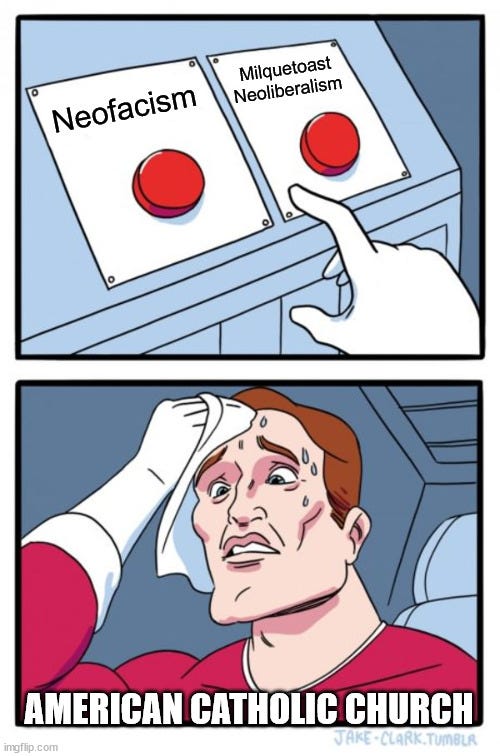
Beyond undermining faith in democracy generally, Barron & Co. undermine faith in American politics in particular. Beside ignoring abortion, they also largely avoid any salient matter presently facing the United States. True enough, not all issues touch on the meaning of democracy. But many current ones do. How should Catholic social teaching inform our approach to white supremacy and the malingering effects of chattel enslavement? (One commentator does briefly address this, and we will discuss later.) How should the teachings of a child refugee inform our views on this nation’s fundamental hostility to immigrants of color? How do we reconcile the Prince of Peace’s command to suffer the little children while spending several times more than what is needed to eradicate poverty on the military-industrial complex annually? The good Bishop doesn’t say. Rather, his commentators sow the perverted notion of politics’ futility.
We have already touched on the editor’s dismissal of modern American politics as catering to “any interest or appetite” (9). There’s more! Dr. Gary Morson’s bit on Alexander Solzhenitsyn’s (in)famous Harvard Commencement Address tells us that humans are inherently evil and that efforts to mitigate the material conditions driving people to evil leads simultaneously to the camps and to decadence (99–101). And Tom Hoopes’ Is Democracy Ethical? recounts his travails and disillusionment as a young Catholic Republican House staffer aiming to gut Medicaid in the early 90s. “I was a true believer. Democracy wasn’t just not as bad as other systems of government; it was a positive good . . . I headed to Washington, DC, to be part of the scene . . . Then reality set in” (50). After the exuberance of the 1994 election, Republicans failed, more or less inexplicably in Hoopes’ telling, to deliver on their Contract with America. “Making sausage is never as clean as you planned it” (53). To be sure, Hoopes offers some nice words, “just because the game is human and messy doesn’t mean good can’t come of it, and it doesn’t mean good Catholics should refuse to play it” (54). But, without an account of how Catholics ought to play the game, steering between the parallel seductions of evil and decadence, the words ring hollow.
The primary blow lies in Matt Paolelli’s discussion of the 1939 film, Mr. Smith Goes to Washington—the heartwarming tale of the naïve Jefferson Smith (Jimmy Stewart) who, appointed to serve out a vacancy in the United States Senate, finds himself embattled on all sides by money-grubbing politicians and insatiable interest groups, but who through righteousness ultimately triumphs in his successful filibuster of a corrupt dam-building deal. Paolelli adopts wholesale the portrait of politics as a nest of lies and deceit. (Set aside whose policies presently encourage the proliferation of money in politics, the obvious anti-government symbolism of Mr. Smith’s first name, “Jefferson,” or Paolelli’s praise of Smith’s supposed moral use of the “filibuster”—slavery and white supremacy’s favored crutch in the Senate.) We are told Smith’s corrupt governor desires it, so it must be wrong! (Oh, and also ignore the Hitler Jugend overtones of Smith’s wish to set aside the land as a “national camp for boys” in 1939) (29). “Like Smith, we must fend off the corrupt temptations of power, money or influence when they compromise our principles” (31). What principles? How does a dam compromise them? What great evil flows from providing infrastructure, irrigation, and electricity (don’t worry, no one is discussing environmental concerns yet) from those who plainly cannot afford it themselves? And why should Mr. Smith’s individual notion of right and wrong unquestioningly carry the day? Look, flawed humans make politics a dirty business, just glance through Lincoln’s debates with Douglas. But look at the ultimate results of those debates! And obviously the other side in the movie is presented as bad; it’s a story. But by adopting this framing wholesale, Paolelli casts off the entire business of political compromise, that is, building consensus through deliberation and passing legislation for the public good, as categorically immoral livestock trading in the Temple. The solution to corruption in politics is sunlight, not shutting it down (as Paolelli’s filibuster would), or abandoning the game to the corrupt.
To be sure, wholesale Catholic abandonment of American politics does not seem the volume’s goal. But it doesn’t have to be. Why disenfranchise when you can disaffect? Same end; less work. As usual, the point seems innocuous: when politics dissatisfies, go home and pray on it. Dr. Michael Hanby’s discussion of Augustine’s City of God—the empire-justifying trauma dump of (as my father put it) an old man who’d never seen (nor wanted to see) a ballot box in his life—concludes with the lesson that our ultimate goal lies utterly outside the temporal realm and exhortation to find repose in faith no matter what happens here (111). More pointedly, Fr. Leonard Andrie offers a masterful hedging on the state of American politics, warning that “[d]evotees of secular movements unfortunately often express their hope to change the world entirely in the political arena and therefore believe and act as if politics is the most important and primary activity of humanity.” Is he warning against reactionary Catholics’ idolization of Donald Trump? Is he dismissing “secular” liberals and leftists for putting faith in politics and rather than Christ? The text permits either, and Andrie doubles down! “As the general election approaches in November, you are challenged to participate in the electoral process by prayerfully and courageously voting for those political candidates who best espouse God’s will as express in the teachings of Christ.” Set aside that, as more knowledgeable Catholics tell me, Church teaching directs us to vote in accord with the “common good,” rather than pretending to divine “God’s will.” Andrie’s approach is not merely equivocation between the gathering storms of fascism and socialism (just pretend for the moment), but ambivalence:
The most significant battleground is not the political or legislative landscape but rather begins within the individual human soul.
It is not the political ballot box that will save us and our country but rather divine love.
(143–44). Oh yes! As Molotov-Ribbentrop collapses around us, let us remember: “His will be done!” How cheap is personal salvation attained as my neighbors are rounded up for the camps.
Good Catholics ought to know that the solution to disappointment in all things, big and small, personal and political, is not just to pray on it, but to pray on it while working as hard as ever! No wonder Augustine’s polemic against the Romans (here let’s give the old man his due) ignored their manifestations of faith and focused on the material:
What concerns us is that we should get richer all the time, to have enough for extravagant spending every day, enough to keep our inferiors in their place. It is all right if the poor serve the rich, so as to get enough to eat and to enjoy a lazy life under their patronage; while the rich make use of the poor to ensure a crowd of hangers-on to minister to their pride . . . It is a good thing to have imposing houses, luxuriously furnished, where lavish banquets can be held, where people can, if they like spend night and day in debauchery, and eat and drink till they are sick: to have the din of dancing everywhere, and theatres full of fevered shouts of degenerate pleasure and every kind of cruel and degraded indulgence.
(109). As Marx said “show me your means of production and I will show you your ideology,” so Augustine said “show me the world you have built and I will show you your god.” Augustine rightly collectivizes and institutionalizes Christ’s challenge: did you feed me when I starved; clothe me when naked; care when I lay ill? So look not into your hearts, American Catholics, but out your windows. Do we grow enough food to feed all? Do we produce enough to clothe all, to house all, to care for all? If so, how do we instead expend our resources? War. Genocide. Environmental destruction. Border walls and concentration camps. Women bleeding out in parking lots. Children bleeding out in schools. Those are your gods. At least the pagans admitted it.