

At long last, back to the Catholics. So far, we’ve discussed Bishop Barron & Co.’s various assaults on democracy. Starting with an immature notion of democracy as a merely procedural device lacking moral validity in and of itself, the good Bishop proceeded 1) to place the Church’s dusty moral agenda beyond communal reproach; 2) undermine Catholics’ faith in American politics; and 3) dismiss the malingering impact of white supremacy as simply God’s will.
In this (likely final) episode, we tackle a growing danger: Christian Nationalism, which we may distill as the notion that the default (read: preferred) American citizen is a Christian—all others relegated to varying degrees of secondary or subsequent tiers of citizenship or belonging. Of course, the folks at Word on Fire display the good sense to serve this garbage indirectly. So, strictly speaking, they never come out directly for Christian Nationalism. Rather, they dismiss it as cause for alarm and muddy the waters. But the simple takeaway is that Christian nationalism isn’t a problem because America is (and should be) already a Christian nation. Naturally, given all the preceding, the bases for that conclusion paint a disturbing picture of both America and Christianity. Let’s dive in.
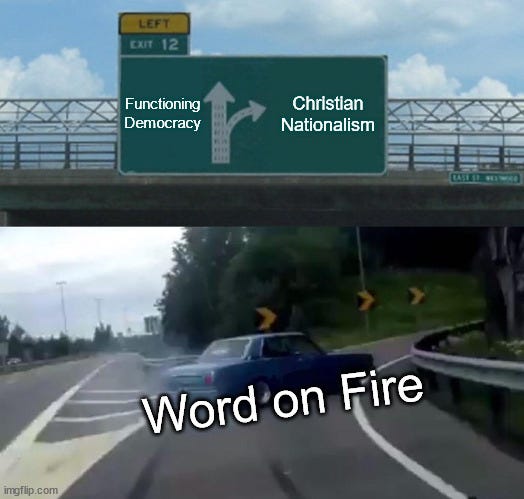
As usual, Barron & Co. shroud the ball, but they don’t delay it. The Vogelin Review’s Paul Krause comes out swinging in his essay, The Spirit of Religion & the Spirit of Liberty: Remembering Tocqueville’s Democracy in America, with this dismissal: “Turn on the news at any hour on any day, and you are likely to find someone opining about the danger of growing authoritarianism and the threat of ‘Christian Nationalism’ to the future of democracy” (23–24). The University of Tennessee’s Kody Cooper agrees that we shouldn’t worry about Christian nationalism, that “fashionable term of opprobrium” usually “wielded as a partisan weapon for political gain against conservative [curious admission] Christians” (73-74). Why not?
In what seems merely a page-long digression within his essay, On the Christian Origins of American Politics, Cooper pretends to engage with some political scientists’ “Christian nationalism scale.” In fact, he cleverly shifts the field of play. Pay no attention to those who would agree that the “[F]ederal government should declare the United States a Christian nation” with all the “evo[cations of] an establishmentarian, exclusivist vision in which non-Christians are excluded or relegated to second class citizenship.” No, no. Christian Americans’ adherence to the various other propositions on the survey scale—that God has ordained the United States’ role in the world, or that the government should advocate Christian values, not enforce the separation of church and state, publicly display religious imagery, and allow prayer in public schools—evince not an invidious bid to subjugate others. Rather they illustrate the dedication of Americans of all stripes, colors, and creeds to a moral code that underlies our democracy. Who could forget Delaware Democratic Senator Tom Carper’s vote against confirmation of Tom Price as Donald Trump’s Health & Human Services Secretary in 2017 reasoning that Price’s opposition to the Affordable Care Act contradicted Christ’s command to care for the needy. Could he be accused of Christian nationalism? Besides, Cooper assures us, separation of church and state is a Christian doctrine. “So much for [that] bogeyman” (74).
Now, the adroit reader might grasp a few…uh…quirks in the argument. For one, prayer has never been prohibited in school. The Supreme Court has merely prohibited teachers from leading, and thereby inculcating, students of varying creeds in the teacher’s preferred rite (in violation of both the students’ free exercise and their parents’ right to direct their upbringing—which I’d sworn was a right conservatives liked). For another, early-American Puritan minister Roger Williams (dm me for an exact page in Chemerinsky’s Con Law textbook) premised his advocacy for a strict separation of church and state on the protection of religion from secular interference (paging the Council of Nicaea?). Though, the Supreme Court has never actually adopted such a view, which would prohibit states and localities from providing fire, police, and basic utility services to religious institutions, let alone let government institutions recognize the religious diversity and even secular-meaning of the holidays—unless I’m just imagining all the manger scenes, lights, and Christmas trees in front of city halls my entire life. But leave all that aside. Let’s try to take Cooper seriously on his own terms: Christian nationalism isn’t a problem because Christian values breathe life into American democracy. What does that mean?
In one sense, democracy’s dependence on Christianity is the running theme of the volume. Recall, Barron’s own introduction observed:
Now, if one peruses the history of political philosophy prior to the emergence of Christianity—consulting, say, the works of Plato, Aristotle, and Cicero—one would be hard-pressed indeed to find any ringing affirmations of equality and human rights.
Democracies . . . are founded in moral absolutes . . . [a]nd these nonnegotiable truths in turn are logically correlative to a belief in a Creator God.
(1) (set aside that Barron’s concept of political philosophy spans only the Western Canon—to be fair, so does mine, but at least we know that). And Word on Fire’s Director, Dr. Petrusek, added:
Where, then, can we locate all three of the fundamental principles [human dignity, human equality, the common good] that are necessary for a just democracy? Catholic social thought saves the day again . . . Catholicism not only supports democracy. It is, in fact, democracy’s greatest friend—and like all good friends, it’s there to offer firm corrective guidance when needed.
(3). The hypothesis that Democracy and Christianity share several substantive tenets strikes me as entirely reasonable. But that’s not really the direction Krause and Cooper take.
Both begin with Alexis d’Tocqueville’s Democracy in America, though they approach it from slightly differing angles. As Krause frames it, Tocqueville’s “real thesis” was that “the genius of American democracy was its birth from an explicitly Christian spirit” (24). He focuses on centrality of religious practice in early America, that is, the church as the locus both of communal life and of congregational decisionmaking, both spiritual and temporal. Cooper focuses more on Christian morals “as the essential condition of freedom.” The Massachusetts Bay Colony’s Old Testament-based law code (the classics: murder, rape, adultery, lying, slander, theft, etc.) provided the footing for its “explicit social compact” theory of government, the Mayflower Compact. “There is a liberty of corrupt nature, which is affected both by men and beasts to do what they list…But there is a civil, a moral, a federal liberty, which is the proper end of authority; it is a liberty for that only which is just and good.” (70). And both rightly note the belief in human equality, Krause “in Catholic doctrine” (brought by early 1800s immigrants) (25), Cooper emphasizing the Puritans’ belief (70).
To be sure, the centrality of religion in early America cannot be doubted. And the Puritan notion of governance by covenant and century of experimental self-rule surely offered American democracy surer footing. But these are supposed to be ideological foundations to flesh out. Neither author addresses how the Puritan notion of the covenant with God led to the compact theory of government, how it converged with the Catholic (or Puritan) notion of human equality in the democratic tenet of the consent of the governed, or (in Cooper’s framing) what substantive moral tenets of Christianity offer the “surest pledge of freedom” (71). Rather than intellectual strains upon which democracy might develop, Krause and Cooper appear to view these religious bases as incantations heralding a fully formed democracy’s genesis from John Winthrop’s head, because they jump to some wild—and telling—conclusions.
Krause’s digressive first leap sets out the pair’s aesthetic notion of both history and religion:
[Tocqueville’s Democracy in America] explicitly explains the uniqueness of American democracy and why the totalitarian revolution that swept France didn’t sweep America: Christianity.
(26). To be sure, one could fairly and intelligently center Christianity in a comparison of the two revolutions without resorting to rank Christo-American exceptionalism. One might contrast the prior century of American Puritan experimentation with government by compact—man ought to rule man just as God covenanted with the Hebrews—under Stuart benign neglect with Bodin’s Catholic absolutism—all legitimate authority flows from God to Pope to anointed monarch—ruling France (Montesquieu and Rousseau merely theoreticians at this point), though I suppose that would tend to criticize Catholic thought leading up to both Revolutions. And it might also prompt an inquiry into driving material conditions, setting the relatively cushy American ideological resistance to Hanoverian-Parliamentary reassertion of authority (e.g., the Proclamation of 1763 and the various intolerable taxes) against with the abject material collapse of both the necrotic French bureaucracy—which (unless I’m very much forgetting the Rest is History podcast episode from last summer) had forgotten how to call the Estates General—and economy following several bad harvests. Thus Americans, already relatively acquainted with democracy, enjoyed several decades of relative material prosperity and geographic insulation from European affairs while the French attempted to cut their democracy from whole cloth, hemmed on all sides by skeptical-to-hostile neighbors (and, oh yeah, have we mentioned the perennial bad harvests?).
This aesthetic worldview infects Krause and Cooper’s more relevant conclusions. For his part, Cooper (skipping past his deeply unserious page on the Declaration and Constitution’s adoption of ordinary Anglo-American, and necessarily Christian, idiom—e.g., the Gregorian Calendar and Sunday as the customary rest day) contrives the Declaratory Act—Parliament’s assertion of legislative supremacy over the Colonies—as some sort of heretical pretense to unbounded Parliamentary positivism. Set as aside that the basic justice of democracy does dictate a limited positivism, Cooper would recast a tax and land policy revolt nominally (if justly) based in the argument “no taxation without representation” as a theological freedom fight from the boot of Anglican tyranny (is it irony for a Catholic to trumpet this cause?). Of course, really following the theological thread—that “[s]upreme or unlimited Authority can with fitness belong only to the sovereign of the universe”—would lead us to the substantive bases of democracy. If no man may wield God’s authority to rule without consent, what alternative form of government might man justly enact over man? (Hint: democracy).
Meanwhile, Krause meditates on famed equality of our burgeoning slave empire because Americans sort of welcomed Christian immigrants from other parts of Europe:
[A]s Tocqueville’s magisterial work shows, it was the belief in human equality, with human being made in the image and likeness of God, and the quality of human capacity that permitted inclusive [wait isn’t this a bad word for conservatives?] politics to extend to people of a different nation and different language to help build the United States of America.
(26) Ah yes, the transcendent diversity and inclusion of 1830s America. Compared to the Puritans’ penchant for banishing each other for every minor theological difference (squinting, of course, between the chattel slavery plantations, huddled masses driven along the Trail of Tears, and the distinct lack of women in the public sphere) the Jacksonian concept of universal white-male suffrage must have looked a wondrous accomplishment for equality indeed!
The point here should be peaking through. Christianity and democracy do substantively overlap. Historians (Tom Holland of the Rest is History podcast comes to mind) have illuminated the fundamentally Christian roots of Western thought, particularly in the notions of mercy and pity embodied in the beatitudes—“blessed are the poor.” The Greco-Roman tradition did grasp some basic universal human dignity. But, at least in the Western canon, the notion that we should cherish the poor in and of themselves, that the greatest should lay themselves down for the least, is a distinctly Jewish and Christian tenet. Indeed, it is from this Golden Rule that Harvard (and for once I don’t mean that as an indictment) historian James Kloppenberg draws one of his primary tenets of democracy: reciprocity—or, in Jaffa’s phrasing, the mutual recognition of equal human dignity upon which citizens submit to each others’ votes (Kloppenberg, Toward Democracy 22, 40–41 (2016)).
Krause and Cooper’s seeming failure to draw this thread isn’t accidental, it’s precisely the point. They’re not seriously grappling with the substantive overlap between Christianity and democracy. Never once do they address the Puritans’ utterly exclusive notion of a small congregation of the faithful deliberating under God (70). Never once do they grapple with Christian (Doctrine of Discovery anyone?) justifications of genocide or enslavement. Never once do they consider how the tenets of equality and reciprocity and the covenant converged into democracy. Never once do they consider how those universal Christian tenets applied to anyone other than their preferred American citizen. And perhaps most telling, never once do they consider how Christ’s command to treat your neighbor as yourself contradicts the exclusive notion of nationalism in the first instance. For Krause and Cooper, then, the Christian-roots of democracy are not really the human equality (and corollary consent/covenant) that mark democracy as the only just form of government by man and the reciprocity that extends it to all but rather an American Christian aesthetic which betrays an exclusive notion of nationality limited to the “Godly” and punitive adherence to the Church’s rigid (and democratically unaccountable) moral dictate. Cooper gives away the ballgame: “[I]nstitutions of tyranny and despotism would be necessary to hold an irreligious and immoral people in check” (72).
While Krause and Cooper’s justification for American Christian nationalism are purely aesthetic, their ramifications are anything but. According to the Supreme Court, corporations claiming religious exemption can decline to provide women the healthcare coverage otherwise demanded by businesses operating in the public sphere. Little Sisters of the Poor v. Pennsylvania (2020); Burwell v. Hobby Lobby (2014). Religious schools can openly fire teachers for disability or other disfavored medical reasons, exempted from basic workplace civil rights legislation. Our Lady of Guadalupe School v. Morrisey-Berru (2020). High school football coaches can lead their players in prayer on the field, making roster decisions based on whether children participate. Kennedy v. Bremerton School District (2022). Religious business owners can discriminate against LGBTQ folks, claiming exemption from basic civil rights legislation. 303 Creative v. Elenis (2023). Irish Catholics funded violent insurgent activity in Ireland for decades of the last century, that one didn’t even require a court case! The list goes on. Conservative Christians justify all of this as no more than their right to free exercise under the First Amendment. But one can’t miss that this “free exercise” usually rests on someone else’s subordination. Make no mistake, these privileges belong distinctly to Christian and Jewish Americans. Try rolling out your prayer mat on the 50-yard line. Try denying service to a gay couple on some other (brown person) religious basis. Try sending funds to a mutual aid society in the Middle East (actually, don’t—you’ll get a prompt and unpleasant visit from the FBI).
Perhaps the irony here is the substance of the aesthetic. Barron & Co. are entirely correct. America is a Christian nation. Christian doctrine ordered America’s discovery. Christians colonized it. Christians eradicated the native population. Christians enslaved the men and women who built it. Christians flocked to it. Christians reaped the bounty. Christians have always made this nation’s law. And Christians have always ruled it. Our form of democracy began in churches. Our money proclaims, “In God we trust;” our pledge, “One nation, under God.” Our default citizen is Christian. Our favorite holiday is Christmas. And our law prizes Christian practice over all others. We deride any deviation from calcified Christian moral, social, and economic norms as satanic, aesthetic, or secular. And Christianity provides the greatest rebuke to our founding principle: If God creates but one man destined for eternal damnation, then all men are not created equal. If God condemns any to eternal damnation, then all men are not equal objects of Gods’ love. So why should we submit ourselves to their vote? Spare me the theological nitpicking. We who recite the emperor’s creed (which ignores Christ’s ultimate command and instead focuses on the minutiae of his substance) every week at mass have no ground to dismiss any of this nationalism as “un-Christian.” Christians enacted every aspect of America’s inequity.
So again, at bottom, America is a Christian nation. The question for us then is whether, despite that fact, it can ever really be democratic.