

I really wanted to put election diagnostics behind me. But liberals keep opening their mouths. So here’s one final shot:
It’s hard to cling to the belief that the Democratic Party really wanted to win the Presidency. With the popular vote still up in the air (even if she ultimately lost that, too), Kamala leapt to concede the raw Electoral College margin, reifying Democrats’ twenty-four year old tradition of bending over backwards to the broken scheme. Never mind that the Fourteenth Amendment directs us to strip votes from States engaged in voter suppression, or that the Supreme Court directed Congress to address (op. at 13) Trump’s ineligibility for office under the same Amendment. The next day, President Biden inexplicably touted the “the integrity of the American electoral system,” as though any system so stuffed with misinformation and money can be “honest . . . fair, and . . . transparent.” Let’s pretend that Republicans didn’t deliberately distort the Electoral College vote allocation via the facially unlawful bid to include a citizenship question in the 2020 Census (forgot about that, didn’t you?). Are we really supposed to believe, in the ten years since the Supreme Court relegalized voter-suppression in Shelby County v. Holder, and in the various cases approving such attempts since (e.g., Brnovich v. DNC), that Republicans haven’t been suppressing the vote?
Frankly, it’s difficult to believe Democrats didn’t choose to run against Donald Trump again on January 21, 2021. Especially on a seven million vote margin of victory, the botched January 6 coup d’etat granted Democrats a golden opportunity to lock Trump away, expel insurrectionists and their sympathizers from Congress, and wield both the House and Senate supermajorities to dismantle the white nationalist Republican threat for generations in ways that FDR could only have dreamt of. Instead they begged performance artists Kristen Sinema and Joe Manchin to torpedo their legislative efforts, and hemmed and hawed before belatedly appointing Jack Smith knowing full well that an openly-partisan Supreme Court (including three justices who had asked and a fourth who had agreed to steal the 2000 Presidential Election) need only tap the brakes on genuinely novel (if easy) questions of law to push the matter into the next Presidential term (not that Smith waited even that long to drop the charges).
If Democrats had openly abandoned the procedure of democracy, more and more we learned, they had abandoned the substance too. Between their increasing hostility to Latin American immigration and their unrepentant enabling of a genocide seeking to purge all apparently unwelcome according to a mythic Bronze Age land grant, Democrats have not only reinvigorated racial animus in American politics but further granted legitimacy to the notion of America as an ethno- rather than credal-state. Why should anyone believe their eulogies for affirmative action if Democrats do believe some people fit for subjugation and annihilation? And despite grasping the constitutional import of women’s bodily autonomy, they utterly lack a vision of legislative supremacy—either to defend what little remains against an emboldened Court or to take those rights back.
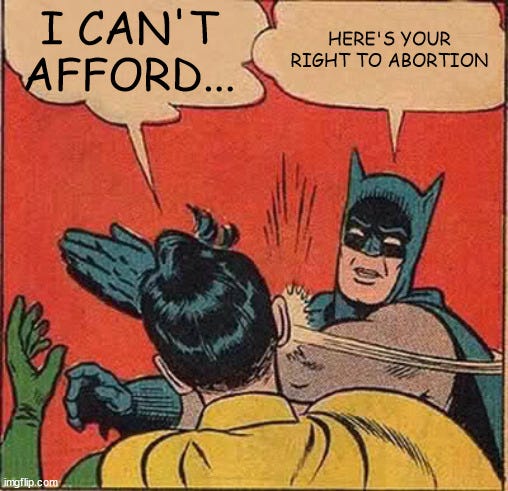
Instead of offering a straightforward plan to improve people’s lives, Democrats opt to berate voters, dismissing their material concerns—the costs of housing, living, and healthcare—as secondary to the trimmings of modern liberal democracy. But abortion rights for those who cannot afford food or housing, let alone healthcare, mean little more than freedom of speech means to the enslaved. This is not merely the pragmatic recognition that a politician must take the voters as she finds them; that just as fearful people vote fearfully, so too desperate people vote desperately. It is the foundation of democracy: communal self-government is inseparable from personal self-government. The equal dignity that entitles one to freedom from enslavement also entitles one to order her own affairs. No one can dictate whether another is hungry, is happy, is scared or not—whether she should be or why is beside the point. To dismiss voters’ concerns about the cost of living is to rule them as one dismisses a dog’s pleas for second breakfast. Freedom means little to the starving. Democracy inheres in the simple dignity of each to vote based on whether they can put food on the table. Plainly, voters are entitled to vote their stomachs.
None of this excuses or justifies many voters’ racism and misogyny. But it doesn’t have to. If Democrats want to play good guy, then they don’t get to simply point to a worse alternative. They have to actually do good: improve people’s material conditions. Until they propose to do so, they have no right to win. Instead of recognizing and working with the material difficulties facing most, Democrats purport to dictate what voters should want. The real takeaway seems to be that Democrats don’t just lack a vision of democracy worth fighting for; they lack one altogether.
The author’s argument is pretty compelling. Point being, if change is to occur it won’t come via today’s Democrats. Third parties never seem to work but what else is there?