

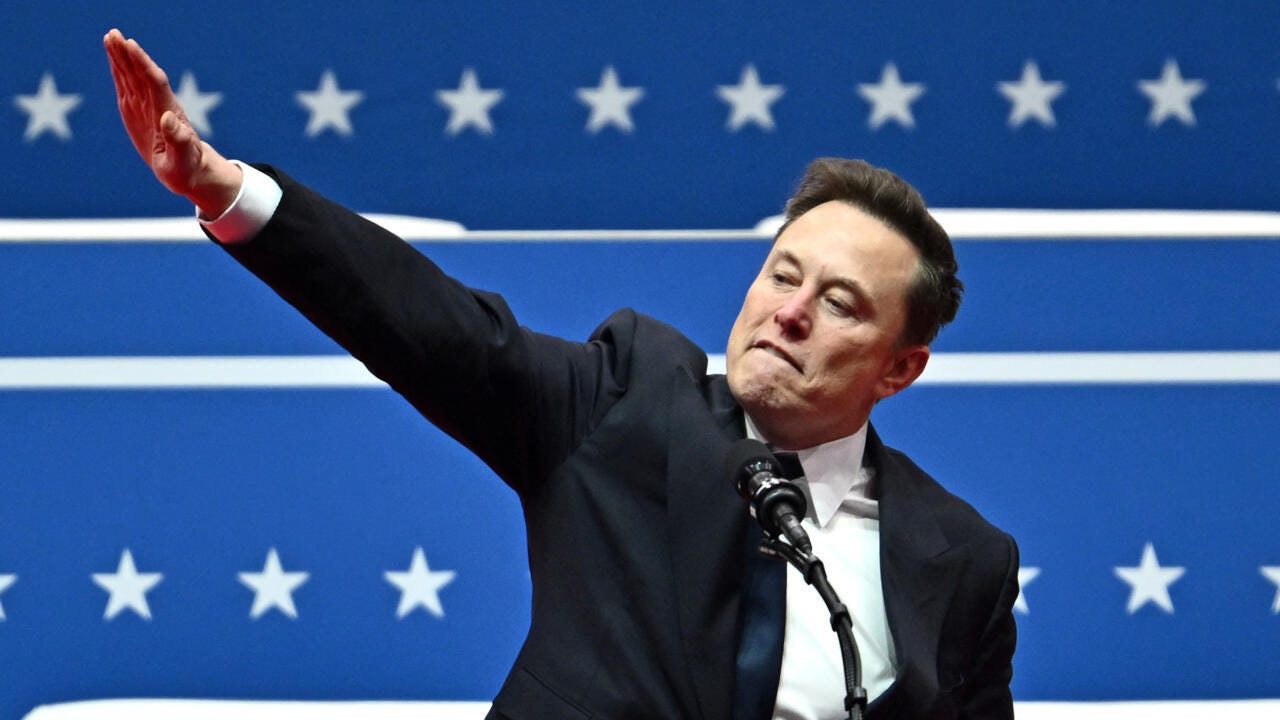
Yesterday evening by executive order, The Leader gutted the Constitution’s guarantee of birthright citizenship, prohibiting Federal agencies from recognizing the citizenship of Americans born not just to undocumented immigrants but to parents holding less than permanent lawful status. Anyone who tells you this is just about better interpreting the Amendment’s text is full of shit. It risks gratifying the argument to even note that the “jurisdiction” of the United States includes (at least) all the land literally and actually controlled by the United States and makes no distinction of how someone got there—except in very specific historically recognized (and pragmatic) circumstances: the murky Federal recognition of Native American tribal sovereignty; diplomats; and hostile occupation—that is, control—of U.S. soil. Might the Court’s sense of stare decisis quash this? Some think so (this is probably the best argument). I doubt it. Long-standing precedent didn’t save the administrative state or LGBTQ+ civil accommodations, among many others. But for now the point is this: anyone telling you that the Courts will block this crap, because at least unlike racial and gender equality, this one’s actually in the text of the Amendment, is full of shit. The text doesn’t matter.
It didn’t matter this past Presidential Election when everyone from the Supreme Court to Democrats rolled over to hand the office to a man textually prohibited from holding it by Section 3 of the Fourteenth Amendment: “No person shall . . . hold any office, civil or military, under the United States . . . who, having previously taken an oath . . . as an officer of the United States . . . to support the Constitution of the United States, shall have engaged in insurrection or rebellion against the same . . . .”
It certainly didn’t matter this past summer when the Supreme Court declared Donald Trump to be our sovereign god-king, appointed to make law but not be subject to it. After all, no bit of the Constitution actually declares the President to be above the law (which would be weird considering (s)he takes an oath to uphold it, Article II, Section 1, Clause 8), Article I, Section 3, Clause 7 tells us plainly: “Judgment in Cases of Impeachment shall not extend further than to removal from Office, and disqualification to hold and enjoy any Office of honor, Trust or Profit under the United States: but the Party convicted shall nevertheless be liable and subject to Indictment, Trial, Judgment and Punishment, according to Law.”
This is no MAGA innovation. Bill Clinton’s Democratic Party rolled over in 1997 when the Supreme Court announced its modern scorched-earth policy against the Reconstruction Amendments. But we have to backup a step. After the Court rejected brown peoples’ claims of religious discrimination in Employment Division v. Smith (the peyote case), Congress realized, holy crap, this reasoning might apply to white people! So they passed the Religious Freedom Restoration Act (and back then, the Catholic Bishops were the holdouts—worrying that religious freedom would let Jewish women get abortions; my, how times change). RFRA essentially overruled Smith and reimposed heightened scrutiny of laws imposing a substantial burden on religious practice. In a nutshell, it amounted to a Congressional declaration of the substantive contours of Americans’ right to religious exercise.
The test case, City of Boerne v. Flores, should never have made it to the Supreme Court. Burdened religious practice really had nothing to do with it. When the City rejected San Antonio Archbishop Flores’ petition to expand a historic landmark church, Texas state courts should have smacked the City Attorney upside the head. How else would the good Archbishop ensure continued funding for the upkeep of the edifice but by expansion and cultivation of tithes from a vibrant parish community? And if we can trust the Catholic Church to do anything well, it would surely be a singular focus on preserving beautiful old churches. Did that stop the Supreme Court from making a Constitutional case out of a local zoning dispute? Of course not. (Reader, do not channel your inner U.S. District Judge and exasperatedly ask students “why the fuck is this case in Federal court?” It will get you called into the Dean’s office.).
To liberal-favorite Justice Anthony Kennedy, RFRA exceeded Congress’s authority. No matter that the Fourteenth Amendment declares that “Congress shall have power to enforce” the grant of citizenship to all. No matter that Congress overtly drafted the Fourteenth Amendment to provide firm foundation for the Civil Rights Act of 1866—which explicitly delineated the first round of rights which Congress believed necessary to United States citizenship, including, rights to transact, hold, and inherit property, and to contract, sue, and give testimony. Oh, and no matter that the Great Emancipator himself had proclaimed that if the Supreme Court alone could decide Constitutional questions, the United States would cease to be a democracy. Nope. Something something, congruence and proportionality (ahem, States’ Rights). According to Kennedy, only the Supreme Court may declare or modify substantive rights. History be damned. Text be damned.
Boerne was bad (and gave us equally brainless decisions like Shelby County v. Holder {freeing states to suppress the Black vote} and Trump v. Anderson {hamstringing Congress’s ability to enforce Section 3 of the Fourteenth Amendment}), but if we’re being serious, we have just about never interpreted the Fourteenth Amendment to mean what it literally says. It had a decent fifteen years. The Civil Rights Act of 1866 really was just the first round. Congress then divvied the South into military districts and conditioned Southern States’ readmission to the Union on their ratification of the Fourteenth Amendment (something Republicans are beginning to bitch about again). The Civil Rights Act of 1871 gave President Grant sweeping powers to wield the Union Army in defense of the Freedmen’s civil rights and cut Southern State courts out of the equation altogether by extending immediate Federal jurisdiction to civil rights claims (plaintiffs would no longer have to sue in state court first and then finagle their way to Federal court via “removal” jurisdiction). And the Civil Rights Act of 1875 extended equal civil accommodations (service at restaurants, hotels, pubs, theaters, railroads and other transportation—anything held open to the public) to African Americans, ninety years before President Johnson would have to do it again. Because in 1883, the Supreme Court decided that the Fourteenth Amendment did not mean precisely what it says.
The Civil Rights Cases are generally taught (if at all) in Constitutional Law courses as the origin of the “state action” doctrine: the invention that the Fourteenth Amendment limits State, not private, action. Set aside the Court’s laughable dismissal of the Thirteenth Amendment as Congress’s basis for civil accommodations legislation: “It would be running the slavery argument into the ground to make it apply to every act of [racial] discrimination . . . When a man has emerged from slavery . . . there must be some stage . . . when he takes the rank of a mere citizen, and ceases to be the special favorite of the laws.” How did the bright sparks of the United States Supreme Court cage the Fourteenth Amendment as a mere “prohibition” of State interference with citizens’ privileges and immunities, due process, and equal protection? By ignoring the first sentence of the Amendment: “All persons born or naturalized in the United States, and subject to the jurisdiction thereof, are citizens of the United States and of the State wherein they reside.” What does it mean to be a citizen of the United States? According to Section 5: whatever the hell “Congress” says its means. Highlighting the idiocracy, Justice Bradley remarked that such a plain reading of the Fourteenth Amendment would violate the Tenth Amendment’s reservation of powers to the States. Yes, Reader. The Supreme Court blinked at the notion that the Amendment totally reconstructing the balance of State-Federal authority contradicted the original balance.
Since at least 1868, Congress has had the textual Constitutional authority to delineate and enforce the substantive contours of American citizenship: sustenance, education, housing, healthcare, bodily autonomy and protections from gendered violence, criminal procedure, environmental preservation, and anything else Congress can imagine! But if you try making that argument at any law school in the country, you’ll almost certainly get laughed out. The State Action Doctrine is so engrained in the American legal psyche that we cannot even bring ourselves to read the plain words of the Fourteenth Amendment. And there’s the rub.
That doesn’t mean we should give up, or that we should celebrate too much if by some miracle birthright citizenship survives. The Courts can do a lot of harm by digging into Dred Scott v. Sandford’s never-actually-overruled distinction between Federal and State citizenship, by stripping the procedures that enable Americans to prove their birth here, or by further stratifying the racial and wealth tiers of citizenship we already have. But it’s time to get acquainted with reality: Text has never mattered to reactionaries with guns. Welcome to the big time.
This is the best (and clearest) installment of Seditious Conspiracy yet. With chapter and verse, Bobby points out how SCOTUS has been ignoring the plain text of the constitution, both recently and in the past. This hurts an old originalist like me because it hints at the real possibility that the Court will abolish birthright citizenship, even though it is PRESCRIBED in 14A, indeed will rush to do so while DT is in office.