

As the shitstorm of stupidity rages, we find ourselves this week having to address yet another Constitutional Law 101 topic that Republicans have apparently forgotten: yes, judges have always been able to enjoin unlawful executive conduct. That one goes all the way back.
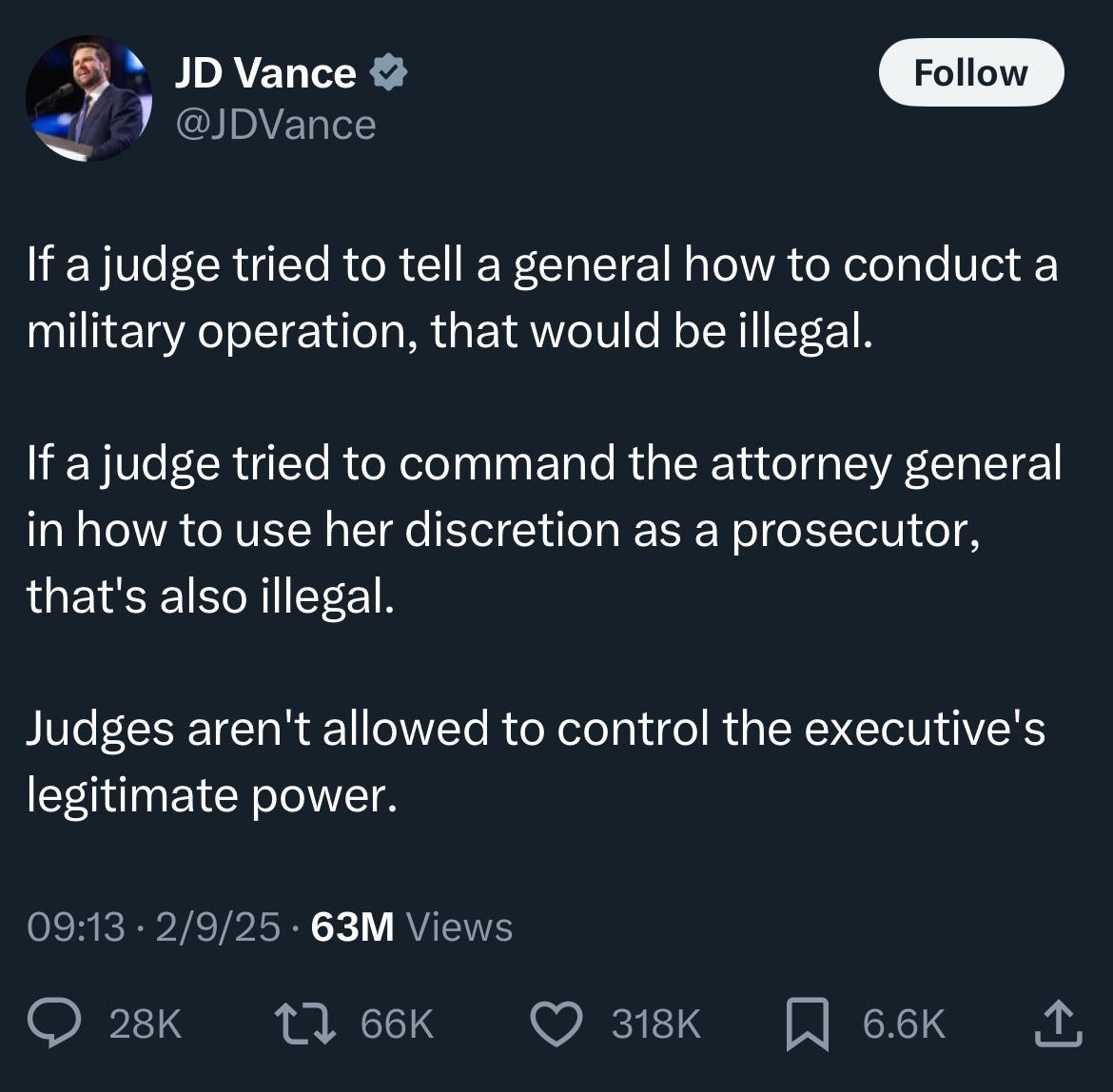
JD, of course, isn’t actually complaining about Federal courts telling Donald that he can’t fire Pam Bondi, or how to conduct military operations. He’s complaining about Federal judges telling Donald, Elon, and their cronies to stop violating actual Federal law, like this one in which U.S. District Judge Paul A. Engelmayer “blocked Elon Musk's Department of Government Efficiency”—which, to be clear, is not actually (or lawfully) a Federal agency, “from accessing Treasury Department records that contain sensitive personal data such as Social Security and bank account numbers for millions of Americans.”
You can set aside the argument that individual district judges should not be able to issue nationwide injunctions. Intelligent commentators on the left have been noting that for years, and Republicans didn’t care when it was Matt “I’m the FDA now” Kacsmaryk in Amarillo screwing with women’s access to mifepristone nationwide, among all the other ways Republicans have used the courts to foul up Democratic Presidents attempts to, you know, be the President. None of this is in good faith. Judges are admirable defenders of democracy when they go off the rails for Republican purposes, but raging Marxist activists when they enforce the rule of law against Republicans. That story isn’t new. What is new is the sweeping notion that Federal judges have no authority to enjoin Presidential misconduct. As I mentioned already, yes, they do. They always have.
In an act of petty for the ages, and in an attempt to stack the Federal judiciary with Federalists against the incoming Jefferson administration, the outgoing John Adams spent the last night of his Presidency signing judicial commissions.[1] But like all deadline labor, some stuff got left on the printer. Several commission letters, including for one William Marbury, bore Adams’ signature, but in the midnight rush hadn’t been sent out by the outgoing Secretary of State (and brand new SCOTUS Chief Justice) John Marshall. Without it, Marbury couldn’t actually take his seat on the bench. When James Madison assumed the Secretary of State’s desk, Jefferson directed him to place those forgotten commission letters (including Marbury’s) into a drawer to languish. So Marbury waited. And waited. Finally fed up, he sued Madison, demanding delivery of his commission letter.[2] And either in hubris or ignorance, he sued directly in the United States Supreme Court. And the rest, as they say, is the first instance of the United States Judiciary striking Congressional legislation for its inconsistency with the Constitution.
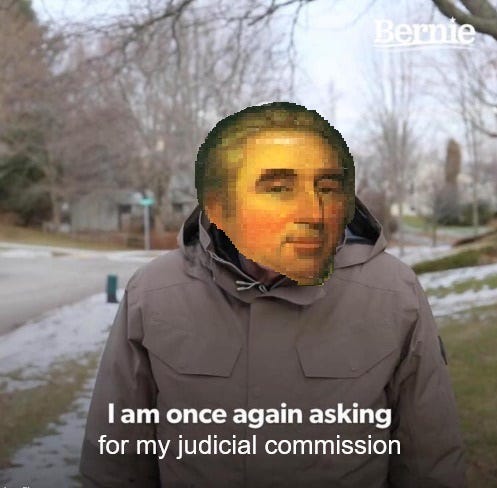
As my second-year Federal Courts textbook put it—and yes, I’m using my little itty-bitty baby lawyer learning book to make absolutely clear how easy and settled this stuff is—
Typically, one thinks of the case that follows—Marbury v. Madison—as establishing conclusively the federal courts’ authority to invalidate Acts of Congress as unconstitutional. It did that, to be sure.[3] But Chief Justice Marshall’s opinion for the Court also grappled with another question that we take as a given today: judicial authority to judge the legality of actions taken by the officer of a coordinate branch of government and to direct that office to comply with federal law.
We don’t need to get into the specifics—they’re really not particularly interesting. But we can follow along with Marshall’s logic. If the law tells someone to do something and they don’t do it, the law provides recourse. “[W]here a specific duty is assigned by law, and individual rights depend upon the performance of that duty, it seems . . . clear that the individual who considers himself injured, has the right to resort to the laws of his country for a remedy.”[4] It really is that simple.
True enough, some things are committed to the Presidents’ discretion. You can’t sue for his choice of Attorney General, even if he’s a moron credibly accused of sexually assailing minors. And the President can fire cabinet secretaries for any reason—or none at all! And of course the President as Commander in Chief basically gets to decide whether or not it’s more important to defeat Germany first even though Japan bombed Pearl Harbor. These things (and more) are all, by tradition, or statute, or a little of both, understood to be less a matter of Congressional directive and more of Executive judgment. If you don’t like it, vote him out.
But, of course, that does not mean that the President gets to lock up people without due process just because of their ethnicity; or nationalize the steel mills without Congress’s permission; or shut down agencies Congress has created, funded, and staffed. None of this means the President gets to just ignore the law. Where Congress directs, the President had better act. Of particular note for John Roberts and his coterie of Presidential immunity dimwits, Marshall explained:
[W]hat is there is the exalted station of the officer, which shall bar a citizen from asserting, in a court of justice, his legal rights . . . It cannot be pretended that [Executive] office alone exempts him from being sued in the ordinary mode of proceeding . . .
[W]here [an executive officer] is direct by law to do a certain act . . . it is not perceived on what ground the courts of the country are further excused from the duty of giving judgment that right be done to an injured individual, than if the same services were to be performed by a person not the head of a department.[5]
That is, the Founders themselves established that if Congressional legislation tells the Executive to do something, he had better do it, and if he tries not to, the Federal judiciary has not just the power but the duty to order him to do it.
The Founders would have been familiar with an old illustration of law taken from James Harrington’s 1656 imagining of an ideal democratic-ish state, The Commonwealth of Oceana: two girls, sharing a cake, divide the roles between themselves. One cuts, the other picks. Naturally, she who cuts does so down the middle, lest she receive a smaller slice. Without relying on either’s generosity, both receive an equal share. No academic division of the girls’ labor into legislative, or executive, or judicial buckets. No appeals to natural law. Just make it work.
As we muddle through the next four years, Republicans will have their nerdy theories for why we have to do this heinous act, or why the law doesn’t protect that disfavored minority. Harrington’s parable cuts through the crap. At bottom, law and politics aren’t about theory, they’re about results. Our separation of powers either constrains Donald Trump and his cronies to follow the law, or it doesn’t. Our government either works, or it doesn’t.
[1] Richard H. Fallon et. al., Hart & Wechler’s The Federal Courts & the Federal System 26 (7th ed. 2015).
[2] Erwin Chemerinsky, Constitutional Law 1–2 (7th ed. 2024).
[3] Well . . . not quite. Marbury v. Madison illustrates a much softer form of judicial review than this quote makes out. But more on that . . . someday.
[4] Hart & Wechsler’s at 61.
[5] Id. at 62–63.
Yup.