

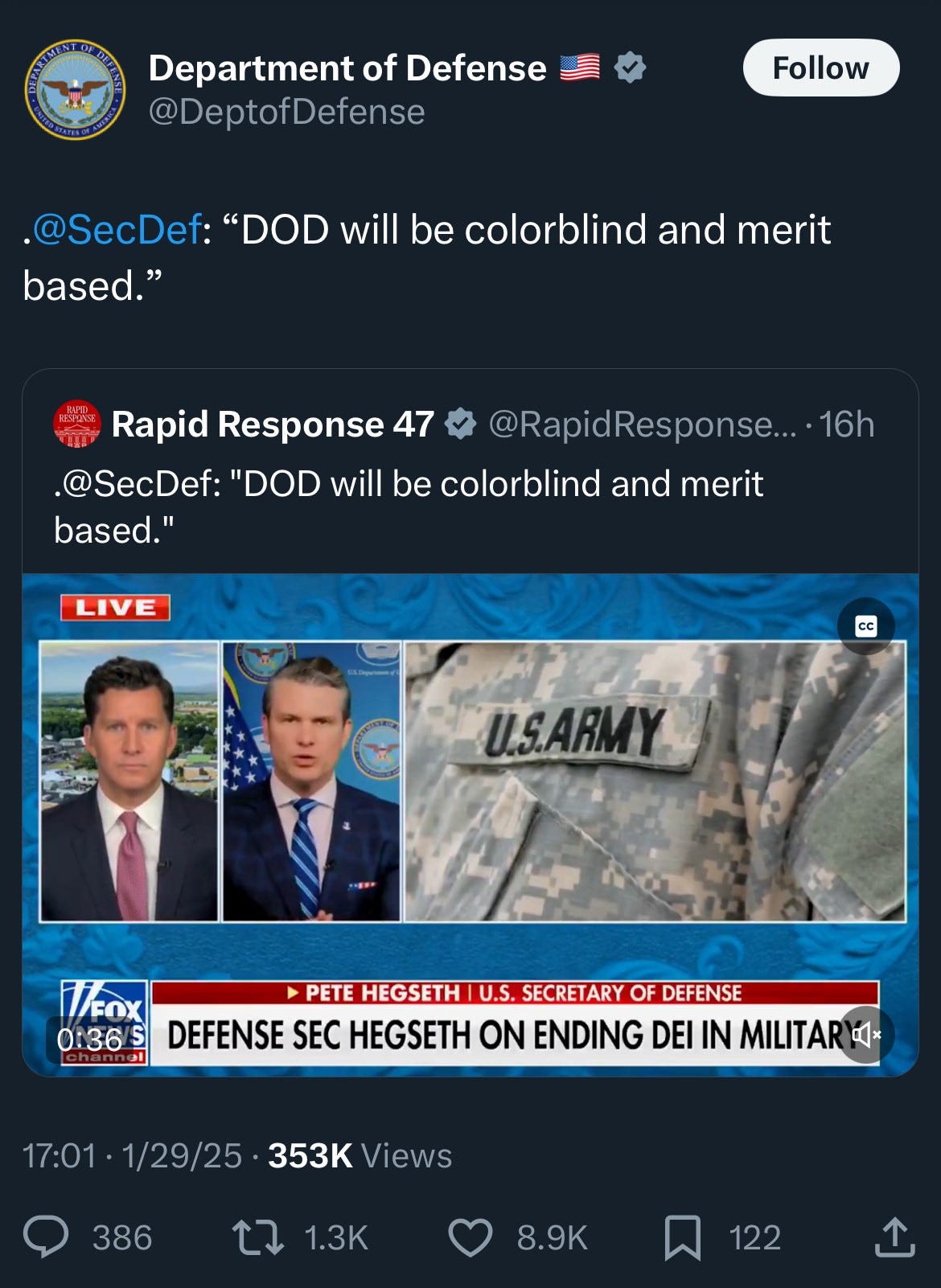
Of all the damned things people say to affect intelligence—utilize, synergies, dynamism, I went to [insert Ivy League University here], we begin with the text, we live in a republic not democracy—“Our Constitution is colorblind” might be the worst. The phrase has made a remarkable comeback in the last few years, even jumping from the pages of the United States Reports to the Secretary of War’s appearances on Fox News, and will likely continue to pop up each time the Trump administration finds a new woman or person of color to wrongfully blame or hound from the Federal bureaucracy. “Our Constitution is colorblind!” Supreme Court Justice John Marshall Harlan protested in his famed dissent from Plessy v. Ferguson’s blessing of “separate but equal.” Is our Constitution colorblind? What does that even mean? And should it be? Strap in.
A. Reactionary Colorblindness.
Take a step back. Constitutional interpretation too often devolves into a meaningless academic venture. What is actually going on here? Of course, we know that for Pete, “colorblind” and “merit based” just means circling the wagons around mediocre white men (God, I hope I’m not one of them) getting jobs (phew, safe) and holding power at the expense of qualified women and people of color. But Harlan said it, and more polished rightwingers have been using the phrase for a while. So it’s worth probing. What do reactionaries even mean when they proclaim, “our Constitution is colorblind.”
Reactionary proponents of the “color-blind” Constitution zero-in on a single phrase in the Fourteenth Amendment. “No State shall make or enforce any law which shall . . . deny to any person within its jurisdiction the equal protection of the laws.” We call it, creatively enough, the Equal Protection Clause. Let’s just, for now at least, ignore historical context and the rest of the amendment.
For the most part, reactionaries envision a colorblind interpretation of the Equal Protection Clause as an absolute bar against racial consciousness by government actors (some more radical interpretations include private businesses, too, but that’s for a different time). What does that mean in real life? No affirmative action. No diversity initiatives. No cognizance of race. Why? Willful historical ignorance. Slavery was abolished. Jim Crow abandoned. “The way to stop discriminating on the basis of race is to stop discriminating on the basis of race.” Chief Justice John Roberts proudly proclaimed in 2007’s Parents Involved in Community Schools v. Seattle School District No. 1, striking down the City’s gradeschool integration efforts.[1] “Eliminating racial discrimination means eliminating all of it,” he repeated two summers back, ending affirmative action in undergraduate admissions.[2]
The Chief’s cutesy profundity masks an insidious agenda. In plain English, what’s the problem? To most, “discrimination” is a dirty word, evoking racial or gender distinctions drawn for purposes of subordination. But in the law, “discrimination” can take a simpler definition: drawing a distinction or difference. An infant discriminates between parents’ faces. A teacher’s discriminating look implies not wrongdoing but discernment of subtleties. Indiscriminate action applies to all, difference or not. And so, conservatives argue, our Constitution’s prohibition of race discrimination does not just prohibit discrimination against people on the basis of race, prohibits drawing racial distinctions or differences, indeed any racial cognizance at all, in the law. We call it the anti-classification notion of Equal Protection.
In most cases, it works. One’s race should have nothing to do with their riding a bus or a subway; eating at this restaurant or that pub; enjoying this theater or that ballgame; whether they may attend school or university; or whether they may marry, move about, sue, give testimony, serve on a jury, contract, transact property; whether they may be paid for their labor; or indeed whether they may assert ownership over their own body. But there’s the catch. As soon as the first enslaved person arrived in this country against their will, race has always mattered to every one of those example, and many more. This nation did not enslave all comers. Our Founders “ma[d]e slaves of whom they [thought] fit”[3]—on the basis of race. Emancipation took just as much cognizance of race—one does have to see color to realize that only black people are being enslaved—but not to subordinate, to remedy. And so legal progressives offer an opposing view of Equal Protection’s prohibition against race discrimination: anti-subordination. Race discrimination is not merely the cognizance of race but discrimination against a disfavored group. So the State and Federal governments may take race into account, if only when necessary and carefully done to eliminate racial subordination.
But this has all been too academic. Everyone says slavery is unlawful and that people may no longer be barred from public transit or restaurants on account of race. The real difference between the conservative anti-classification and progressive anti-subordination notions of Equal Protection lies in their response to the unabated material legacy of slavery. As soon as you take down the sign denying them entry, a black American can step onto a bus, into a restaurant, or attend gradeschool. For many parts of life, such anti-classification on the basis of race works. But life isn’t that simple. For one, you can’t just hand a ballot to people who have been denied education and literacy and pretend it will work. For another, it takes money to make money. And Emancipation didn’t come with cash, or land, or a home (recall, forty acres and a mule), or, for that matter, any means of sustenance.
Were that the end of it, racial disparities in wealth, education, and health would likely persist, as bare Emancipation left black Americans economically dependent upon their former enslavers. But that wasn’t the end of it. Emancipation and Reconstruction gave way to Jim Crow. For eighty more years, while the Federal government threw land at white settlers across the West, and university educations and cheap home loans at generations of white men, America denied black citizens integrated gradeschool education, access to most state and private universities, and graduate schools. Sure, the GI Bill theoretically gave black men equal access to home loans and university educations as their white colleagues. But between exclusion from or tight racial quotas in universities, and red lining and racially restrictive covenants effectively prohibiting black home ownership, such equitable benefits proved largely illusory. So while white America built intergenerational wealth and enjoyed its concomitant educational, health, and social benefits—black America couldn’t.
The material legacy of slavery continues today. As of 2019, the average white American family wealth stood at $188,000; black families averaged $24,000. White households enjoyed a median income of $76,057; black $45,438. Black homeownership trailed white by 25 percent, tended to be worth less, and were subject to higher property taxes. Black student representation at state flagship universities still lags population percentage, and black students graduate with substantially more student debt. All of this trickles into graduate education and professions. Black Americans comprise 13% of the population but only 5% lawyers, and only 25 of the 1800 CEOs of Fortune 500 companies. Wealth saps health. Black children suffer twice the blood lead levels of their white compatriots. Black men are twice as likely to die of prostate cancer; black women twice as likely to die of uterine cancer; and black mothers four times as likely to die in childbirth.[4]
Reactionaries’ “colorblind Constitution” rejects not just efforts to integrate gradeschool and university to eradicate the material legacy of slavery—it rejects race conscious efforts to remedy that material legacy wholesale. The “colorblind Constitution” marks not an academic inquiry into some obscure matter of Constitutional interpretation. Reactionaries see these racial disparities, the material legacy of a slavery they profess to damn, and in the name of a “colorblind Constitution,” don’t care.
In the immediate term, this is no good faith matter of interpreting our written Constitution, just a diversion.[5] Indeed, reactionaries offer each of Hirschman’s three reactionary theses in their fight against affirmative action: raising the specter of rampant and never ending racial quotas (perversion) (“Twenty years later, no end is in sight!”);[6] the undermined legacy of Emancipation and Reconstruction (jeopardy) (“The time for making distinctions based on race has passed.”);[7] and even that affirmative action efforts must ultimately prove futile as black students, raised above their station, will inevitably fail to compete with their counterparts (futility) (“[Affirmative action] policies sort at least some blacks and Hispanics into environments where they are less likely to succeed academically relative to their peers.”).[8] Yet on a deeper level, the debate between equality as anti-classification and as anti-subordination, of our refusal to remedy the malingering legacy of slavery, of black American’s quest for recognition of their equal human dignity—that strikes the core of our Constitution. So long as we tolerate racial subordination, turn our backs on the tenet that no one may rule another without her consent, we too reject the Declaration: that “all men are created equal.” And so long as we reject that, we have no right to call America a democracy.
B. Neither Knows nor Tolerates.
Taken seriously, the debate over the “colorblind Constitution” proves anything but. Anyone arguing it must first confront Harlan’s original text.
But in view of the Constitution, in the eye of the law, there is in this country no superior, dominant, ruling class of citizens. There is no caste here. Our Constitution is color-blind, and neither knows nor tolerates classes among citizens. In respect of civil rights, all citizens are equal before the law. The humblest is the peer of the most powerful.
Harlan indeed wrote what reactionaries now proclaim, “Our Constitution is color-blind,” but his statement continues. Our colorblind Constitution “neither knows nor tolerates [racial] classes.” Of course, a colorblind view would not “know” race. How could one who refuses to see color simultaneously recognize and tolerate no racial class?
At risk of overanalyzing the text, the whole debate comes down to Harlan’s use of “is.” Because the deceptively simple verb encompasses at least two different meanings, one descriptive and one normative: one stating things as they presently exist, one stating things as they ought to be. The various forms of “be” illustrate. Consider the parental statement, I am your father. Depending on the context, the meaning shifts from pure revelation of fact (we got the DNA test back, I am your father) to a normative assertion of authority (you will listen to me! I am your father) (hell, it can even synthesize the two! Who can forget, “I am your father . . . join me, and together we can rule the galaxy as father as son!”). Similarly, two motorists in court don’t so much as report simple fact as assert facts as they wish them to be when they testify, “the light was red/green.”
None of this should be news to Americans. One our founding charters begins with such a normative use of the verb:
We hold these truths to be self-evident, that all men are created equal, that they are endowed by their Creator with certain unalienable Rights, that among these are Life, Liberty and the pursuit of Happiness.
To read Jefferson’s Declaration as a simple description would be preposterous. To pretend the line accurately described our equal creation by the cosmos would be just about meaningless. All men were not created equal—not even on Jefferson’s own land. They were born into, created for servitude, endowed with no right to life or liberty, let alone pursuit of happiness. Forcing Jefferson’s words into a simple descriptive mode has serious consequences. A large part of Chief Justice Roger B. Taney’s decision in Dred Scott v. Sandford—that black Americans were not and could never be citizens of the United States—revolved around the argument that Jefferson’s failure to secure equality for black Americans meant that he’d never meant for them to be included in the Declaration’s “all men.” Damn Jefferson for failing to implement his principle, but don’t throw the baby out with the bathwater. As Lincoln reminds us, “all men are created equal” marks our continuing aspiration.
So too Harlan’s “Our Constitution is color-blind, and neither knows nor tolerates classes among citizens.” Harlan could not be accurately describing the state of the Constitution. He was writing in dissent! As he wrote those words, the United States Constitution both saw color and openly denied the equal dignity of its black citizens. Certainly by our sensibilities, John Marshall Harlan (“I allude to the Chinese race”) was a white supremacist (and we’ll get to that). But it should offend our notion of plain English to pretend his words, “Our Constitution is color-blind,” demand, let alone imply, an absolute and willful ignorance of race.
C. As is Enjoyed by White Citizens.
Now set Harlan aside. Constitutional interpretation, in a democracy at least, should not depend entirely on the words of one long-dead aristocrat. Admitting that the words of the Fourteenth Amendment itself—“All persons born or naturalized in the United States, and subject to the jurisdiction thereof, are citizens of the United States and of the State wherein they reside. No State shall . . . deny to any person within its jurisdiction the equal protection of the laws”—do not squarely resolve the debate between anti-classification and anti-subordination, their circumstances of their drafting and ratification do.
As soon as they had surrendered, and while they joined in ratifying the Thirteenth Amendment, the former-Confederate States began passing Black Codes to deny freedmen their civil and political rights. So when Congress reconvened in early 1866—having locked out all the former-Confederates the Southern States had tried to reelect—it set to work on two new bills which would become the Civil Rights Act of 1866 and the Second Freedman’s Bureau Act.[9] The Civil Rights Act settled the question of black citizenship. “[A]ll persons born in the United States and not subject to any foreign power, excluding Indians not taxed, are hereby declared to be citizens of the United States.”
Of equal importance, the Civil Rights Act delineated the first round of individual rights Congress thought necessary to American citizenship:
[S]uch citizens of, of every race and color, without regard to any previous condition of slavery or involuntary servitude, except as punishment for crime whereof the party shall have been duly convicted, shall have the same right, in every State and Territory in the United States, to make an enforce contracts, to sue, be parties, and give evidence, to inherit, purchase, lease, sell, hold, and convey real property and personal property, and to full and equal benefit of the laws and proceedings for the security of person and property, as is enjoyed by white citizens.
However justified, this was a wild expansion of Congressional authority at the States’ expense. Some Republican Congressmen argued the Thirteenth Amendment empowered Congress to eradicate the “badges of servitude” and thereby guarantee civil and political equality for black Americans. Not all agreed, though. So even before President Andrew Johnson vetoed the bill, Congressional Republicans began drafting the Fourteenth Amendment to forcefully authorize the provisions of the Civil Rights Act.[10] That is, Congress explicitly drafted the Fourteenth Amendment to authorize its race conscious efforts to eradicate both slavery and its material incidents. And that could be the end of it.
But history only tells us how we got here. It doesn’t tell us how things should be. Next time: should our Constitution be colorblind? Can it be?
[1] 551 U.S. 701, 748 (2007).
[2] Students for Fair Admissions v. Harvard, 143 S. Ct. 2141, 2161 (2023).
[3] Somerset v. Stewart, 98 E.R. 499, 509, 13 Geo. 3 (K.B. 1772) (argument of Serjeant Davy).
[4] SFFA, 134 S. Ct. at 2269–70 (Justice Brown Jackson, dissenting).
[5] See generally Alfred Hirschman, Rhetoric of Reaction (1991).
[6] SFFA, 134 S. Ct. at 2165–66.
[7] Id. at 2160.
[8] Id. at 2197 (Justice Thomas, concurring).
[9] Laura Edwards, Legal History of the Civil War 97–100 (2015).
[10] Edwards at 99, 103–04.
Excellent clear analysis. Especially re Justice Harlan and “colorblind”. As far as I know, Olsen is the first to dig into that particular aspect.