

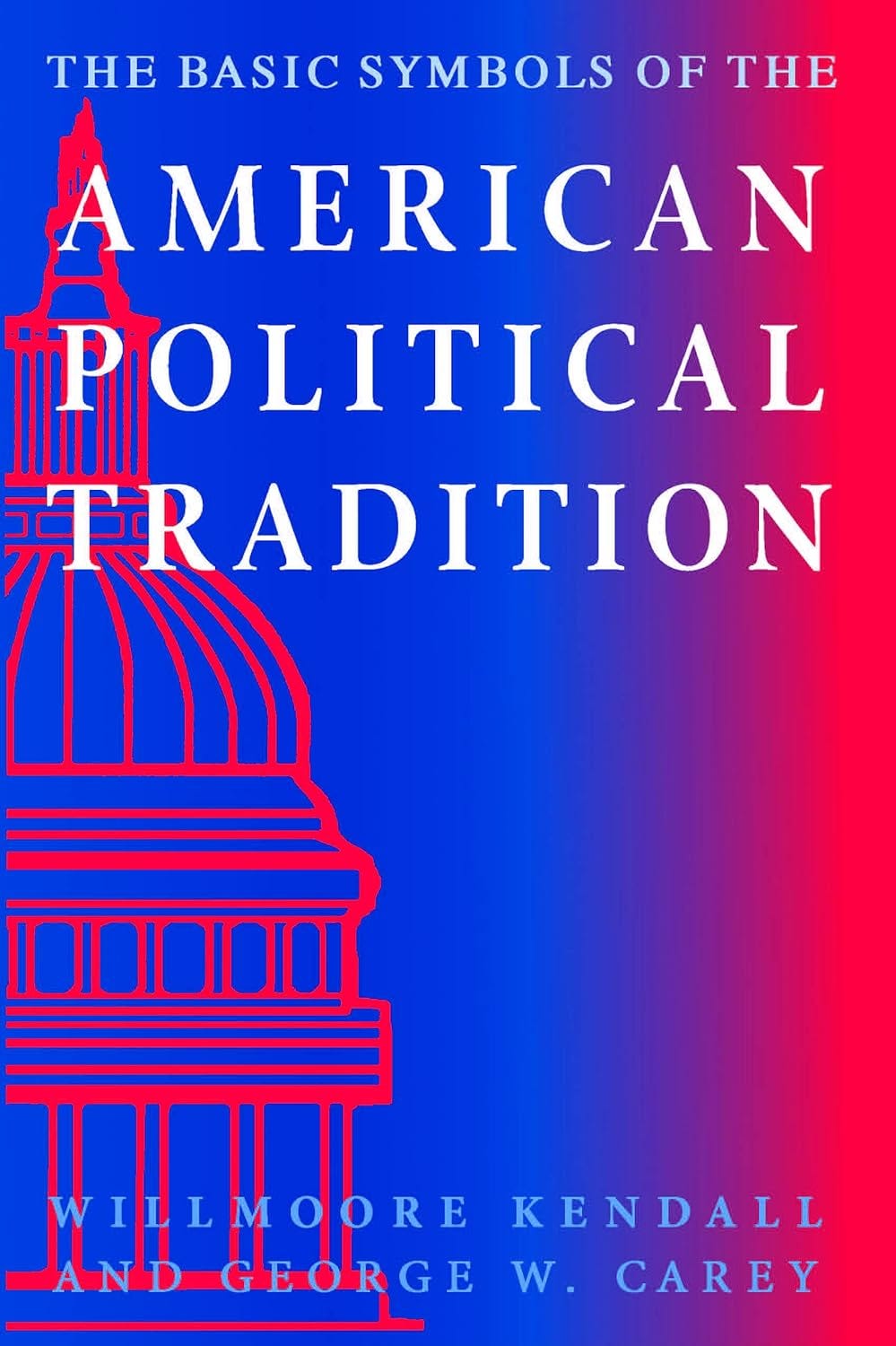
While diving headlong into conservative political tracts might strike most as dull labor, I find fantasy to be an engaging and freeing genre in these troubled times. The then-late Willmoore Kendall and George Carey’s 1970 work, The Basic Symbols of the American Political Tradition, proved just the delight I needed. I laughed. I cried. I hummed, once or twice, at a cogent remark. I laughed again. Actually I laughed quite a bit. And most of all, I learned, once more, that some people are still pretending they weren’t conclusively defeated in the Civil War.
If nothing else, Kendall and Carey offer a clever methodology (apparently borrowed from some conservative eminence, Eric Voegelin, whom I’ve never read): taking seriously as politically revealing the stories, myths, yarns, or tales—symbols as they term them—with which America inculcates its children. For example, what does the myth of young George Washington and the cherry tree reveal about, say, our national need for a secular (dare we say political?) morality, aside from the Commandments? What does the demonstrably-false (for anyone having ever set foot between the 1500-mile expanse from the Sierra Nevada mountains to the Missouri River) claim that a squirrel could once jump branch-to-branch from coast-to-coast without once touching the ground reveal about American land use and resource-extraction policy? Why do so many pasty-white Americans claim native heritage? And what the hell was the point of Paul Bunyan’s blue cow?
Yes, all these, like history, are just lies we tell our children to justify the present. But what do they reveal about that present? That, one must admit, poses a worthy question. Now Kendall and Carey turn this methodology toward somewhat less colorful topics: America’s political charters. But they nevertheless begin where most of our childhood pageantry also began: the Mayflower. And, were one to squeeze her eyes shut and suppress all thought or imagination, Kendall and Carey’s retelling of the American political tradition just about works. Just about.
The American political tradition, Kendall and Carey tell us, begins in the saloon of the Mayflower in 1620 where the Pilgrims, finding themselves somewhat beyond the effective reach of London, have to recreate the King’s peace for themselves. Being good scripturalists they, naturally, put their plan to the page: the Mayflower Compact. Five aspects of the document warrant our attention. The drafters (1) begin with an invocation, “In the name of God,” suggesting their self-conscious deliberation. Remember that, it will be important. They continue, (2) identifying, themselves—though at this stage still as loyal subjects of the Crown. They (3) state their purposes, beginning with the usuals: glory to God, Advancement of the Faith, King and Country; and then more importantly: to combine into a body politic for their better ordering. Not best or perfect, but in good Puritan humility, just better—an ongoing commitment to improved interrelations. The (4) oath, we “solemnly . . . covenant,” reaffirms the self-conscious deliberation already noted, and (5) addendum quickly delineates some procedures and duties to live by: “to enact . . . just and equal laws . . . as from time to time shall be thought . . . convenient for the general good,” along with “all due Submission and Obedience.”
Funny hats and weird accents aside, for a first attempt at a written constitution, Mayflower isn’t half bad. From now on, most American political charters will follow its structure: invocation, identification, purposes, constitutive oath, and an addendum specifying the duties and procedures of the polity. Of course, things will develop. In about twenty years, the Fundamental Orders of Connecticut (1639) will flesh out the “general good” and “better ordering” as maintaining peace and union, maintaining and preserving liberty and the purity of the gospel, and orderly and decent government. And, curiously enough, the Connecticutians won’t even bother specifying the word “covenant” in their oath; Kendall and Carey tell us it’s already implied. Two years further on, the Massachusetts Body of Liberties (1641) will add an important adjective to the oath: “unanimously.” We can’t just form a new state by majority vote; this is too important. Everyone’s got to agree! Skip ahead to the eve of revolution and the Virginia Bill of Rights (1776) gives us the separation of church and state. Not a secular society, mind you. Virginians are still expected to practice mutual Christian love and charity, if given freedom to pick their preferred Rite. But they, like Pope and Emperor long before, have recognized the value of separating spiritual and temporal governance.
Perhaps most important, what Kendall and Carey call just an “addendum” in Mayflower will become the major part of those later documents, including the Constitution itself. Rather quickly, the Connecticutians recognized the need for some procedures of governance beyond the Mayflower’s sparse “play nice together,” giving us the first delineation of a legislative body and its accompanying governor and magistrates. Massachusetts next offered the first “Bill of Rights,” mostly what we would term criminal procedure—and not equal rights yet, mind you, merely those “due to every man in his place and proportion.” But hey, baby steps. Moreover, just because the colonial legislature doesn’t have any formal or legal limits doesn’t mean it’s all powerful. The bounds of humility, civility, and Christianity still apply, obviously. And the Virginia bill raised the first instance of a right (press freedom) which perhaps, in the modern sense, limits legislative power. But this, according to Kendall and Carey, is phrased less as a limitation on the Virginia legislature and more as a maxim of good governance.
The basic symbol should be clear enough by now. Throughout, Americans (well, white, male Americans of certain property) seek by communal self-government to improve their lives. They don’t need extravagant lists of what their legislature can or can’t do. They’re all good, pious men. Christian virtue and consensus will ensure the justice of their lawmaking. Simply put, as Kendall and Carey posit, the supreme symbol of the American political tradition is the virtuous people deliberating under God. Oh say, can you see. Eagle screech.
Thus far (still squinting, remember), Basic Symbols presents as a perfectly acceptable piece of white, conservative, mid-twentieth century political thought. Yes, questions linger. What gave early Americans the notion they were entitled to democratic self-governance? Sure, as Kendall and Carey note, the Puritans just modeled the Covenant on Sinai, and for a biblical textualist, that might be enough—even if it doesn’t really explain why this particular group of upstarts considers itself excepted from the unbroken command to “render unto” from Saul to James (or Charles); nor does it really explain why Virginia’s papaly-curious and presumably less-scripturally-retentive Anglicans would follow the same path. Though, jumping off of that, we’ve discussed precisely three colonies so far. Where’s the rest of the country? Why are we so concerned with an exclusive, home-grown political tradition that we spend half the Virginia chapter scrubbing Locke from the list of influences? Why does our concern with New England legislative supremacy lead to a half-baked diatribe about the hypothetical Mrs. Murphy’s right to choose (read, exclude Black people) her boarders?1 But, hey, this is all just historical curiosity, right? How much of this tradition will actually survive the Revolution, Reconstruction, or experience? Surely we’ll find out. Baby steps, right?
So it comes as somewhat of a shock when Chapter 5 implodes into a gripe fest about the Declaration of Independence and Abraham Lincoln. Apparently, the Declaration of Independence, yes, that Declaration of Independence—Jefferson, Adams, Franklin, George Washington crossing the Delaware, 1776 and all that!—should be viewed neither as a constitutive document, nor as the founding of a nation, but merely as the explanation for revolt; not an organic step in the American political tradition—but a deviation. Founding of a nation? Hogwash! The States were “united” only in lower case, “free and independent” all on their own! (Never mind that they declared independence together, in one Congress, that no state achieved that independence alone, and that they concluded the peace together, Adams, Franklin, & Jay representing not individual but “United States.”) The Declaration can’t rise to the stature of the Mayflower Compact! It gives “no guidance” how to construct a government! (Apparently, we ought to ignore the Declaration’s fundamental guidance, that just government rests on the “consent of the governed,” leaves us but one choice: democracy). And “all men are created equal?” Heresy. Never before mentioned in our political tradition. A single phrase, ripped from context. How does liberty square with equality, after all? Besides, Jefferson obviously didn’t mean it, since he didn’t free the slaves (paging Roger Taney). The best that can be said for the Declaration, Kendall and Carey tell us, is that it correctly notes the King’s interference with the American tradition of self-governance, and that those governments ought to secure men’s rights and consent. More seriously, they say, the Declaration severs our political inheritance in two: one tradition of communal deliberation for the common good; the other of extreme, Lincolnian equality.
Thank God the Philadelphia Constitution returned us to sound five-part tradition. Okay, so we skipped the invocation. But “We the People” is a great identification; “in Order to form a more perfect Union . . . ” (and so on), an excellent purpose; “do ordain and establish this Constitution for the United States of America,” see the “covenant” is still implied! And then, seven articles of addenda. No mention of newfangled individual or unalienable rights or, shudder, equality. Just detailed procedures for slow and methodical deliberation to consensus—who’s to say the majority view isn’t just another faction? The only way to be sure that something is in the public interest is to get the minority on board as well. We’re back! A virtuous people indeed deliberating under God.
And, don’t worry, the Bill of Rights didn’t change any of this. Some people (none of whom were in Philadelphia) were concerned, and consensus-building James Madison convinced the First Congress that it couldn’t hurt to jot down a few aspects of criminal procedure, searches and seizures and trials and whatnot, to ensure their lasting respect. Oh and something about guns, and freedom of speech, within the common law boundaries of sedition and libel, of course. None of this required much debate, because it didn’t much change anything. As always in our tradition, rights only run against executive or judicial overreach; they don’t limit legislative supremacy because they don’t need to. Remember, slow, steady, approaching unanimity. A virtuous people deliberating under God don’t oppress each other.
With a single chapter remaining for Kendall and Carey to both reveal the modern derailment of this tradition and get us back on track, one’s lingering questions can no longer be suppressed. Have Kendall and Carey just dropped us off in 1791 and called tradition accomplished? What about the Civil War? What about Reconstruction? Jim Crow? Civil Rights? For that matter, isn’t it odd that we haven’t once mentioned slavery? And wait a minute, why are we so against equality anyway? Did I mention we haven’t talked about slavery yet?
At last Kendall and Carey reveal their perceived derailment of the American political tradition. The pair likely could not have foreseen how well their framing of the matter would resonate with future audiences living under the aggressively-unintelligent judicial oligarchy of the Roberts Court. Why, they ask, does Congress so regularly defer to the Supreme Court? Don’t blame the Constitution. The Court’s present role as supreme constitutional arbiter finds no basis in the text. On the contrary, the Constitution empowers Congress as first among the branches, wielding both the purse and impeachment. The notion of three coordinate branches comes not from Philadelphia, but from The Federalist. So, they repeat to a cheering audience, why does Congress bend over backwards to the Court?
Except that, to Kendall and Carey, The Federalist is precisely why Congress ought to back down. The Constitutional morality of consensus building between coordinate branches counsels the avoidance of “showdowns.” Congress should wait for wayward justices to eventually die. Congress should, presumably, respect the veto power. In fact, Congress should respect every bit of delay, minoritarian check, and procedural mire. That is, Kendall and Carey have resurrected Congress not in glory, but still crucified! Incapable by design! Our Constitutional morality calls not for majority rule, but for rule “by the deliberate sense of the community.” That majority, to be sure, “has its role in the system; but that role, as we begin to understand, is that of midwifing.” Consensus demands, more or less, “unanimity, obeying the basic rule: The majority must carry the minority along with it, because all men are created equal, as they were in the saloon of the Mayflower, in their capacity to give or withhold consent” (148–49). Oh, now they care about equality.
It is then that one realizes, Kendall and Carey have not, in fact, been unwittingly missing one crucial symbol of the American political tradition. They have, rather, just like the Philadelphia Constitution, been elaborately, obviously dancing about it. The genius of the American Constitution and of the American political tradition lies not the recognition of human equality, the concomitant demand for consent, and the inherent justice of majoritarian democratic rule but in the Constitution’s byzantine tapestry of checks and balances by which the supposedly supreme legislature is beholden not to the majority, but to that disciplined minority that best and most doggedly asserts itself—by which that minority, with due paeans to conciliation and consensus, subjects the majority to its will. The supreme symbol of the American political tradition is not, we discover, the virtuous people deliberating under God. It is the shackle.
In the end, Kendall and Carey might be forgiven for never actually grappling with Lincoln’s teachings because, despite it all, Lincoln’s teachings emerge entirely unscathed: equality, recognized in the moment or not, undergirded the only parts of our tradition worth keeping. So occupied with “identifying the traditional with the good,” Kendall and Carey forget that Jefferson too discerned and distilled the wisdom of his inheritance: “We hold these truths to be self-evident, that all men are created equal, that they are endowed by their Creator with certain unalienable Rights, that among these are Life, Liberty and the pursuit of Happiness.—That to secure these rights, Governments are instituted among Men, deriving their just powers from the consent of the governed?” What else lies beneath the American claim by right to self-governance and independence? Kendall and Carey never say.
Yet it is worth noting that if we take seriously the scriptural basis for Mayflower Compact, the original Covenant, we still reach the remarkable revelation that just as God humbled himself unto death on Golgotha, he had already humbled himself to rule the Hebrews just as man might rule man: by consent. And just as Christ commands us to love another as we love ourselves, so too no man may rule over another without his consent. The virtuous people shall deliberate.
Either way you cut it, then, all men are created equal. Majoritarian communal deliberation is our best and most just form of decisionmaking. And the bounds of that deliberation are precisely the principles that grant its moral legitimacy: equal human dignity. We need not play out here the theological consequences of denying human equality. For our purposes it suffices to say, deny man’s equality, and recourse to the Covenant resolves to no more than the claim, by some lonely group of radicals on a beach in Massachusetts and their progeny, to divine favor evidenced by force of arms alone. That at least explains why, even today, denials of human equality seem to go hand in hand with denials of Appomattox.
The “Mrs. Murphy” provision of the Fair Housing Act of 1968, invoking a hypothetical elderly widow running a small boarding house, exempted those who rented rooms within their single-family home or other units within their small multi-family home from the Act’s nondiscrimination provisions. The theoretical grounding in the First Amendment right to associate (or not) barely concealed the reality, “specifically Mrs. Murphy’s right not to associate with African Americans.” (See Senator Mondale’s explanation at page 2495 here.)
Bobby’s best yet. I learned a great deal here, previously having only the vaguest recollection of Wilmoore Kendall from reading National Review in my high school library 50 years ago. I might ask Bobby to take us to the next step: having defeated the slave power in 1865, did the nation realize that it was re-wiring the Constitution fundamentally by adopting the Civil War Amendments? You’d think that was obvious but go ahead, show us. Good job.