

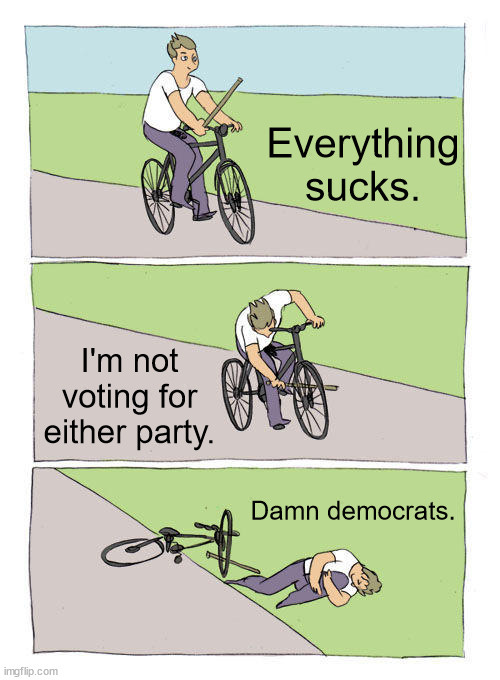
If the endless threats, smattered across my social media feeds, not to vote this election are any indication, the American Left spends too much time reading obtuse theorists who’ve never won meaningful democratic majorities—an odd conundrum for adherents to an ideology whose entire political validity rests on its appeal to and material provision for the majority. I’d like to think that somewhere, perhaps in the works of an aging and disillusioned Engels, or at least in Luxemburg—once the apostles recognized that salvation lay beyond their personal horizons—someone sent some time figuring out: now that we have a political program, how do we win durable electoral majorities to implement that vision long term? But right now, I don’t care. The example the men who refounded this nation should be plenty.
We downplay Abraham Lincoln’s accomplishment when we teach that he ended slavery via the Civil War (spare me for a moment the Thirteenth Amendment’s big exception). To get there, Lincoln had to win election preaching the moral wrongness of human chattel enslavement, and the task had only gotten more difficult over his career.
When Lincoln started out in Illinois politics, the cause of abolition (look, we don’t have time to get into the contours of abolition versus emancipation) didn’t look too shabby. Jefferson had prophesied the end to enslavement in his Notes on the State of Virginia (a complicated work, at best, but I think we can take this part sincerely, if not all its reasoning). Both the Northwest Ordinance, passed by the First Congress, and the Missouri Compromise of 1820 excluded slavery’s expansion North. The United States border confined it South. And Congress had outlawed the import of the enslaved on January 1, 1808—the first date permitted by the Constitution. Then, the United States invaded Mexico to conquer a vast new southern territory for slavery. The Compromise of 1850’s Fugitive Slave Act invited Southerners to wield Federal power (Federal officials duly incentivized to help) to re-enslave people across the North. The Kansas-Nebraska Act of 1854 repealed the Missouri Compromise, opening all Federal territory to enslavement. And in 1857, the Supreme Court declared that Congress lacked authority to prohibit slavery in the territories, plainly opening the door to next declaring that States also lacked authority to prohibit slavery within their jurisdictions. Upon Lincoln’s 1858 return to politics, shit was fucked. By 1868, slavery was abolished and every freed man, woman, and child made a citizen of the United States. Yes, we really goofed things up after that and still have never actually accomplished the multiracial democracy promised. But Lincoln accomplished nothing short of a revolution.
So far as I can tell today, though, many American Leftists would have damned Lincoln every step of the way. He’d supported the emigration (expulsion) of freedmen back to Africa. He’d embraced the racist tropes of day, called his hypothetical enslaved man “Sambo,” recoiled at the notion of interracial marriage, and disavowed any intent to extend political or social equality to black Americans. He wrote to Salmon Chase, asking him to remove opposition to the Fugitive Slave Act from a Republican election platform. He professed the Constitutionality of enslavement; that he had no power—nor desire—as President to interfere with it where extant; that even Congress had no power to abolish it (a lie widely accepted across the legal profession to this day!). When the war started, Lincoln initially stopped his generals from freeing the enslaved. He then proposed compensated emancipation—implying the validity of asserted property right—before moving on to emancipation by military necessity, but only in Confederate territory.
As Lincoln’s detractors gleefully remind us, stepped into the unsavory at every step! But of course he did. He argued black emancipation to white supremacists. If I should like to cross the street, shall I nevertheless stand there like a moron because every step—taken as the ultimate goal—would get me killed? Politics is the art of defining your goal, determining what is immediately possible, and doing that without compromising the next step. And every step enables new ones. Lincoln’s political moderation did not compromise his ultimate principles; it illustrated them. However racist, the public will embodied the democratic consent of the governed that Lincoln thought undercut by enslavement. He could no more ignore the voters than oppose enslavement. That does not mean that, a la Douglas, the voters were always right. They weren’t. But he had to work with them—guide them, even. Lincoln’s political empathy directed him to meet voters where they were. If that meant stepping into the shit with them; so be it. White supremacist rural Illinoisians weren’t going to suddenly embrace interracial egalitarianism. So he offered a race-neutral argument against slavery rooted in his voters’ patriotism and self-interest. Jefferson’s Declaration that “all men are created equal” means that no man is good enough to rule another without his consent—black slavery justified white slavery; slavery would tend to degrade white workers’ conditions; fulfill the Founding Fathers’ promise. He disclaimed any intent to “force” black Americans’ social and political equality on his voters while preaching a political proposition of their equality. Lincoln compromised at every step, all the way to his goal, and laid the groundwork for the Fourteenth and Fifteenth Amendments.
Returning to the present, Leftists have to work with Democrats. We don’t have to be friends. We don’t even have to like them. But our immediate agendas—democracy, gender equality, racial equality, preserving the environment, basic healthcare and working conditions—overlap. Sure, Democrats hold shallow views of each. But a crappy democracy is better than none; vestiges of Jim Crow are easier to work with than fully fledged; interspersed States of female equality-ish are better than none. And I’d rather argue to lawmakers whose supposed values oppose genocide than lawmakers whose ideology openly embraces it. Because if historical materialism means making lives better, rather than just stewing in the opioid of self-aggrandizing moralism, then we have to take those first few steps together from really shitty to slightly less really shitty.
Look, I can’t stand Democrats. I used to believe the Left had a permanent home there and railed against what I saw as Democratic incompetence. Now, I worry that the “incompetence” is deliberate, as the Democrats seek to stitch together the fundamental contradictions of capitalism and multiracial democracy. They’ve known about the Right’s, and more specifically Chief Justice John Roberts’, vendetta against voting rights for decades and done nothing. They continually cede ground to the Right, be it economics, healthcare, or immigration. While admirably staffing the lower courts, they have refused to take the Supreme Court seriously and women have paid the price. They refused to wield the blessing of the botched January 6 coup—casting away a golden opportunity to exclude the insurrectionists from Congress just as the Reconstruction Congress did; impeach and disqualify Donald Trump from future office; and wield a supermajority in both Houses of Congress to rid us of the Electoral College, entrench meaningful voting rights, and reclaim Congress’ rightful role as expositor and guarantor of individual rights—and instead have walked themselves into a contested election! And if that were not enough, they openly support Israel’s maniacal genocide in Gaza based on racial animus thinly veiled by a mythic Bronze Age land grant.
Whatever it once was and could someday possibly be, now and for the foreseeable future, the Democratic Party seems bent toward maintaining a collapsing capitalist mode of production by means of labor and racial- and gender-egalitarian concessions. And yet, against the background of our openly divergent goals, Leftists still debate on Twitter which course of action will make Democrats like us more, or hate us less. If you keep losing, give your interlocutor some credit. If you don’t view Democrats as friends, guess how they feel? Democrats know we are not their friends. They know we’re just allies of convenience at best. So why should they like us? Just accept that they’ll vilify us as the culprit if they lose and ignore us as radicals if they win. But no! Schrodinger’s Leftist wants to be simultaneously the morally superior scourge of neoliberal Democrats while also enjoy their love and support!
What poison let you believe politics to be a cozy business? If it be your lot to die climbing Missionary Ridge that one starving and enslaved child might go free, then it is your duty. If it be your lot to be beaten senseless on the Edmund Pettis bridge that one black child might drink at the same water fountain as a white child, then it is your duty! So then if it be your lot to be ridiculed by plush liberals as we fight for union rights and universal healthcare—then it is your duty. And if it is your lot to cast a ballot for a callous ex-cop tolerating a genocide so that her opponent will not assuredly complete it—then it too is your duty. Let me be clear: My rebuke is not to Muslim and Palestinian Americans, especially those directly impacted by the genocide. I understand completely that one may not be able to bring herself to be electorally complicit in the deaths of family and friends. But for the rest of us, blessedly insulated from the madness, we have a job to do: grasping the best, however poor, chance to end the genocide. Shall I burn the last loaf because to give it to a child condemns the rest to starve? Not voting guarantees worse atrocities to come.
Complain not of the Master’s tools. Those who cast off effective tools for want of perfect ones do his work better than he. Or have you already forgotten that Abraham Lincoln argued, and within seven years won, emancipation for those whom his voters would have expelled from the Continent! To wield a viable political party we must first run viable individual candidates; to run viable individual candidates we must wield influence in a viable party not of our making; and to wield influence within a viable party not of our making we must win that party votes. We make votes for just causes possible tomorrow by voting for the lesser of two evils today. The votes we win for viable Democratic causes today can be converted into votes for our viable platform in future elections.
Despite Joe Biden’s generational work for labor and union rights, the rest of American politics—Dobbs, Bruen, the gutting of the administrative state, slashing of voting rights, the failure of student-loan relief, and the genocide we fund daily—seems like a rear-guard action, and this election like a moment of harm reduction, not of hope. But what selfishness drives one to abandon the world they cannot save within their own lifetime? We have no right to give up, not while a single life can be improved.
Notice how on-the-ground politics never really change. Abraham Lincoln's playbook works today: win first, then do what you can.