

In 1976, the United Supreme Court began holding, beginning with the case of Fitzpatrick v. Bitzer, that although the Fourteenth Amendment to the United States Constitution authorizes Congressional abrogation of the Eleventh Amendment, such legislation would require an increasingly clear statement of abrogative intent. Unfortunately, both the Fourteenth Amendment and much of its statutory implementation predated this holding, creating an apparent logical and temporal disconnect in the Court’s reasoning—a disconnect which threatens the hallowed integrity of American Law. Our story begins on Capitol Hill, Washington, D.C., just outside of the Supreme Court building one sunset in the Spring of 1976 as Captain Kirk, First Officer Spock, and the entire gang of Star Trek characters we all know and love have embarked on a daring mission to save the integrity of American Law as we know it: to deliver a copy of the later Supreme Court decision to the desk of Senator Charles Sumner in the Summer of 1870, thereby apprising the Congressional deliberations over the Civil Rights Act of 1871 of the later precedent, bridging Justice Rehnquist’s apparent logico-temporal-gaffe.
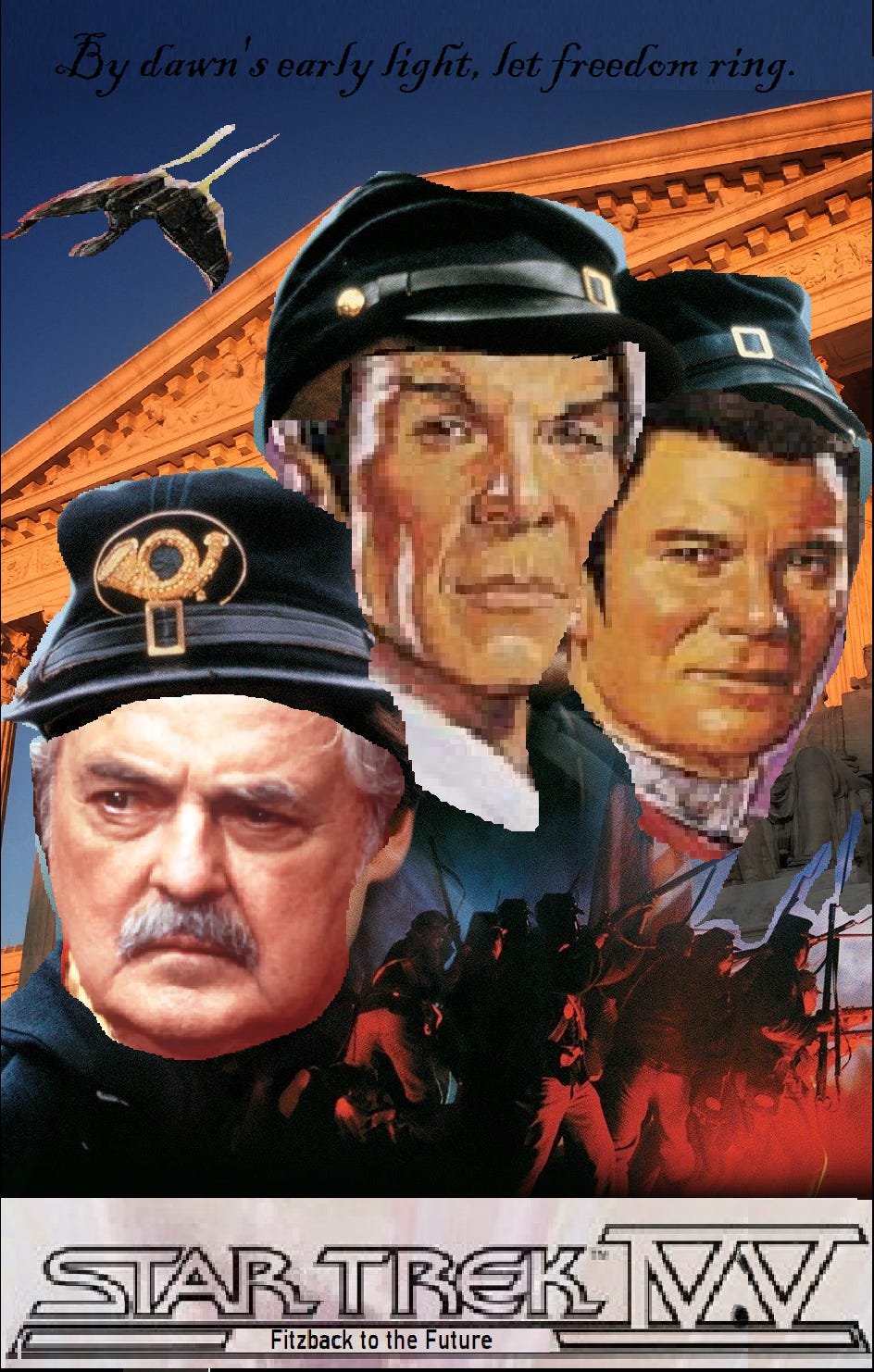
Act One
Scene One.
Sundown; spring 1976. One First Street, Washington, D.C. No music. Evening bugs buzzing and chirping. In the fading light, several darkly clad figures materialize before the memorable façade of the United States Supreme Court. Streetlamps partially illuminate the motto: “Under Law.” Silently, the figures dart from the illumination of the nearest streetlight into the cover of bushes closer to the High Court. Dogs bark and cats meow in the distance, but none appear to have noticed the visitors.
Silently, the intruders gain entry to the building through a side door, evading the guard’s flashlights.
Subdued, if tense, music. Think beginning of the Eder Dam mission in Call of Duty.
Shortly thereafter, the camera pans to a bronze plaque marking a doorway—“Honorable William Rehnquist.” After a few tense moments, the familiar voice of First-Office Spock rings calmly. “Captain, I have found the penultimate draft.”
Kirk, breathless, yet dashing, rounds a corner and steps into the chambers foyer. Lowering the hood of his guise; through the window, the streetlamp illuminates his face. “Good job, Spock,” he breathes.
Suddenly, Lieutenants Sulu and Chekhov (in classic comic relief pattern) clatter in. “Captain!” Chekhov pants, “Court personnel. We need to leave!”
“We just escaped some kids in the library,” pipes Sulu, “what on earth were they doing here at this hour?”
“You were apprised during briefing, gentlemen,” Spock dispassionately reprimands the two, “of that Justice William O. Douglas famously worked his judicial clerks at all hours of both day and night.” Spock’s brow furrows. “I trust you were not spotted?”
Sulu and Chekhov shrink sheepishly. “No sir. They were frantically discussing something.” Chekhov offers hopefully. “Uh . . . trees!” Sulu supplies. “Yes sir. Trees!” (Chekhov). Spock’s demeanor doesn’t lighten.
“Well boys,” Kirk chuckles, stepping in, “let’s not spoil the midnight antimatter for Justice Douglas’ chambers.” Camera pulls out through the chambers window as the gang jogs away in file. Spock’s fading voice heard: “Away team, make for rendezvous delta . . . .”
Tune in next time to continue the thrilling story…