

We made it more or less to the present this past week in Seditious Conspiracy’s American Government 101. I made the students read Roosevelt’s “Court Packing” Fireside Chat and confront the conundrum of Congress not believing it has the power to do what the Constitution pretty clearly tells it that it has the power to do. We read South Dakota v. Dole and considered Congress’s authority to attach all sorts of conditions to Federal funds, assuming they don’t strike John Roberts as coercive (though, how can funding-conditions be coercive if States aren’t entitled to Federal funds in the first place?).
But, most importantly, we grappled with the modern reality that most of your Federal civil rights rest not on Congress’s basically-defunct (more in weeks to come) Reconstruction Enforcement Power, but on the Commerce Clause. Because what screams “lesson learned” from centuries of racialized slavery than pegging civil equality to your joining other goods and chattels in the channels of interstate commerce? I’m only half serious, of course. A mature notion of “commerce” certainly ought to grasp that when we step out our front doors into the civil sphere—created, protected, and ordered by the State—we agree to play by the public’s rules. So it should come as no surprise that a fulsome notion of Congress’ Commerce Clause authority, capable first of dealing with the Great Depression, expanded before too long to the eradication of racialized-denial of public accommodations, employment, and housing. What should come as a shock is that after all that, in the two thousandth year of our Lord, the Supreme Court would resurrect the zombie of James Madison’s utterly-failed Federalism (see, e.g., a little thing call The Civil War) to slap down modern Congressional civil rights legislation.
For our purposes, the modern Commerce Clause starts with 1942’s Wickard v. Filburn, when the Supreme Court upheld Congress’ authority to regulate the agricultural production destined only for local or personal use. But to appreciate the magnitude of this development, a little background will help.
Even if they did not grasp the full extent, the Founders certainly understood the tension between the Commerce Clause and the States’ traditional primacy in the governance of your daily life. On one hand, proponents of a narrower view construed Congress’ Commerce power as limited only to remedying the States’ habit of tariffing each other under the Articles of Confederation. On the other, proponents of national power could point to Shays’ Rebellion as illustrative of the need for centralized economic control, lest the rabble get to leveling. Pretty early in the new Republic, 1824 to be precise, the Supreme Court adopted the latter view. In Gibbons v. Ogden, the Court cut through a morass of competing state licenses and purported-monopolies to operate steamboats on the Hudson River between New York and New Jersey. Those channels of interstate commerce, not to mention the instruments, goods, and people flowing in them, belonged to Congress. States, more or less, had to keep their hands off.
The potential of Congressional power over the channels of and things in would have been apparent to early commentators—even without recourse to the Importation Clause (“The Migration or Importation of such Persons as any of the States now existing shall think proper to admit, shall not be prohibited by the Congress prior to the Year one thousand eight hundred and eight”) admitting Congress’ commercial abolition authority (Congress would, in fact, abolish the Slave Trade on January 1, 1808), the scope of Congress’ power to regulate the channels of and things in interstate commerce would have been hard to miss. But old habits die hard—none harder than State primacy in the governance of your daily life (see, e.g. The Civil War). So the next century of Commerce Clause jurisprudence reflects a delicate Federal(ism) balance between the Court striking down State commercial regulations under Gibbons’ “dormant” Commerce Clause (joined during the Gilded Age by the Fourteenth Amendment) and making up horseshit limitations (commerce v. production, national v. local) to curb Congress’ growing willingness to regulate the national economy.
This mindset, of course, carried us headlong into the Great Depression and animated the Court’s violent reaction to the First New Deal, embodied in the Schechter Poultry decision that Congress couldn’t regulate Schechter’s sale of tainted chicken, even chicken bought and transported across State lines, because that ultimate sale was “local” activity. But then FDR set things straight. (Sure, the Court packing plan fell flat in Congress. But between retirements and deaths,1 FDR got seven nominations and one promotion to Chief Justice in the next four years. So you tell me whether the Court Packing plan “failed.”) And by the end of 1942 in Wickard, the Court had no problem recognizing that Congress’ Commerce Power extended not only to the channels of and things in interstate commerce, but to any activity—however local and personal—that, if we all did it, would substantially impact the national economy. Not so much an expansion of Congressional power, but the Court finally shedding all the horseshit limitations it had concocted over the last century.
The rest should have been history. We know FDR left Federal civil rights for another day, but when it came, it came. Congress sidestepped the thorny Civil Rights Cases and Reconstruction Enforcement Power questions (saving capital for 1965’s Voting Rights Act) and rested the Civil Rights Act of 1964 on the mature Commerce Clause. In a pair of cases, Heart of Atlanta Motel v. United States, and Katzenbach v. McClung, the Court upheld the Act. Racial discrimination in public accommodations, they recognized, however seemingly local, however seemingly private, occurred both within the flow of interstate commerce (that is, Gibbons’ Commerce Clause) and had segregated the entire national economy on the basis of race. Obviously, more discrimination remained to be addressed, but that should have been the end of the debate over Congress’ power to address it.
And you know what? For 36 years it was. Until in 2000’s United States v. Morrison, the Court decided that certain “discriminatory” behavior wasn’t “economic” enough for Congressional regulation. Surveying the States’ utter failure to address sexual violence, in 1994 Congress passed the Violence Against Women Act, giving American women a Federal civil claim (and district court jurisdiction) against sexual assailants, similar to the Civil Rights Act of 1871’s extension of a Federal claim and jurisdiction for racialized civil rights violations. A young woman at Virginia Tech sued after the university failed to take seriously her repeated assault at the hands of a school football player, and the Court had its test-case. Could Congress outlaw sexual violence, a private deed historically under State control?
Following Heart of Atlanta, the justifications could hardly have been simpler. Aside from all the medical and legal costs and other financial ramifications, the prevalence of sexual assault constituted one of the primary historic barriers to women’s access to the national economy, the civil sphere, and the workplace. Congress even put together a giant report detailing these findings. Yet none of that mattered to Bill Rehnquist and Company. “Gender motivated crimes are not, in any sense of the phrase,” Bill told us, “economic activity.” Thus, Congress’ record carried no weight. “Simply because Congress may conclude that a particular activity substantially affects interstate commerce does not necessarily make it so.”
It would be unfair, however, to characterize Morrison as resting on a made-up rule that wouldn’t survive a first-year law student’s scrutiny in light of Heart of Atlanta, McClung, or the Fair Housing Act of 1968. If “economic activity” had been the touchstone then, the entire structure of Federal civil rights would have fallen apart. Racialized denial of public accommodations, employment, or housing constitutes not so much economic activity itself, but a refusal to engage in it. So to Rehnquist’s credit, he does just come out and say what he really means.
The reasoning that petitioners advance seeks to follow the but-for causal chain from the initial occurrence of violent crime (the suppression of which has always been the prime object of the States’ police power) to every attenuated effect upon interstate commerce . . . the concern that we expressed in Lopez that Congress might use the Commerce Clause to completely obliterate the Constitution’s distinction between national and local authority seems well founded.
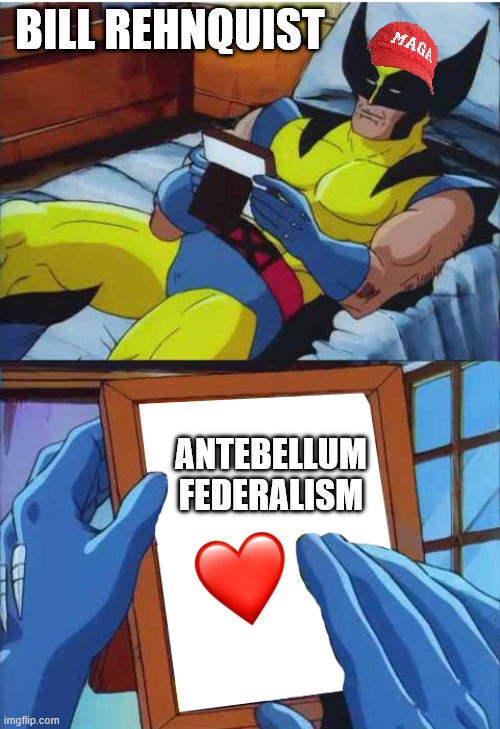
That’s right, folks. “[E]conomic activity” has nothing to do with it—it’s just a facade. Why can’t Congress prohibit sexual violence? Our Antebellum Federalism. The Federalism that tolerated human chattel bondage. The arrangement between the State and Federal governments that walked us right into The Civil War. That Federalism. I would have sworn we buried that at Gettysburg. Or at least with Wickard. But alas, here’s Johnnie.
The Constitution requires a distinction between what is truly national and what is truly local. In recognizing this fact we preserve one of the few principles that has been consistent since the Clause was adopted.
So far as I can tell, the Court has never explicitly pulled back from Wickard, but it doesn’t have to. Today, the Court concocts all sorts of bullshit reasons why Congress can’t legislate. Wasn’t clear enough.2 Wild new interpretation of the Seventh Amendment.3 There’s already more I’m missing; and, if the first-century of Commerce Clause jurisprudence teaches anything, more will come. Morrison’s “economic activity” contrivance makes that clear enough.
But, to close, let’s not lose the trees for the forest. Morrison is a case about a young woman repeatedly assaulted by her classmates; who relived her trauma daily as Virginia Tech investigated, tried, and convicted her assailant, only to commute his pathetic slap-on-the-wrist sentence; who relived her trauma every day for years after that, defending Congress’ power to protect others from going through the same. Morrison might speak in the register of high politics, but it remains first and foremost a case about sexual assault—the University’s failure to take it seriously; the State’s failure to take it seriously; and the Court’s failure to take it seriously.
If you find yourself shocked by the continued revelations that this or that director, politician, judge, or professor has turned out to be a sex pest, don’t be. We picked this course long ago. Under our Federalism, if the McDonald’s fry-cook just refuses to take your order on account of race or sex, the Constitution lets Congress do something about it. But if instead he takes you out back and sexually assaults you, Congress can’t do squat. Bill Clinton’s Supreme Court said so.
Owen Roberts switched his vote. Willis van Devanter retired in ‘37 and died four years later. George Sutherland retired in ‘38 and also died four years later. Ben Cardozo just died in ‘38. Brandeis retired in ‘39, Pierce Butler died; and last, but certainly not least, both Chief Justice Hughs and Jim McReynolds retired in ‘41, and both even survived the war.
West Virginia v. EPA.
SEC v. Jarkesy.
Bobby points out that the Commerce Clause, without more, provides plenty of authority for Congress to legislate in the fields of civil rights, both as to race and sex-based matters. In fact, he shows that Wm. Rehnquist admitted as much but just said "no way, anyway" in so many words.
This matters because the Commerce Clause lies close to the hearts of many traditional (pre-Trump) conservatives. It's something George Washington could--and did--get behind.