
The Political Demand for Compassion
Why we must, to maintain our democracy, account for racial (and other) disparities.

On Wednesday, the Supreme Court eviscerated the last remaining bastion of the Voting Rights Act: Section 2’s prohibition of vote-dilution tactics. I won’t pretend to have carefully considered all of the subtle contours of Sam Alito’s “Fox-News Grandpa” aneurysm smeared across the page. Instead, the decision distills to this:
The Fourteenth Amendment imposes its willful blindness to racial disparities upon the Fifteenth Amendment (don’t worry that the Fifteenth Amendment guarantees that “The right of citizens of the United States to vote shall not be denied or abridged by the United States or by any State on account of race”).
And because, according to City of Boerne v. Flores, Congress may not add to the substantive contours of rights (including the right to vote), if the Fifteenth Amendment takes no note of racial disparities absent discriminatory intent, neither may the Voting Rights Act.
Thus, Congress’ 1982 amendment to Section 2, which for fifty years has targeted proscribed—regardless of intent—racial disparities in voting, no longer does.
Add to this the Court’s laundry list of plausible (to your racist uncle’s ear) “non-racial” explanations for disparities in voting, today, a vote dilution claim requires nigh-impossible proof (again, to uncle’s ear) of discriminatory intent. So, Section 2 remains constitutional, if only because Section 2 now means next-to-nothing. It’s only a hair shy of proclaiming that the Fifteenth Amendment’s reference to, and thus cognizance of, race violates the Fourteenth’s Colorblind Equal Protection Clause.
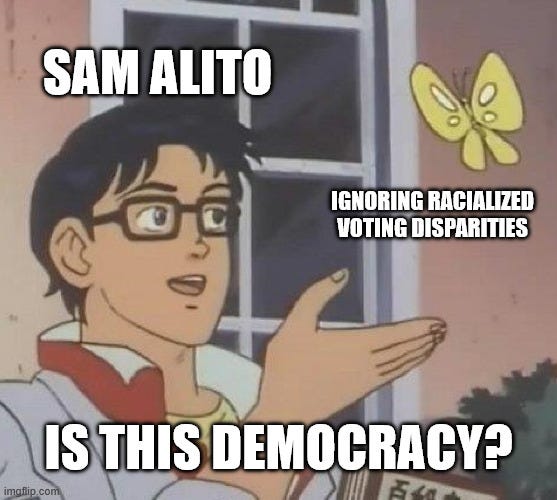
Suffice it to say, Alito gets it wrong on the text, the law, and the history. But on that morass we need not linger. A graver concern draws our attention. For Justice Kagan, in dissent, nevertheless (and unnecessarily) concedes that “The Fifteenth Amendment, all agree, prohibits only purposeful discrimination.” Indeed, to hear Kagan tell it (if you can survive the academic slog), Section 2’s Effects Test (the prohibition of disparate impact, “results in,” that is)—does not reflect the meaning of the Fifteenth Amendment. Rather, Section 2—though it steps out ahead of the Amendment itself—reflects an “appropriate” means for Congress to enforce the prohibition of discriminatory intent in voting.
One wonders where the hell Elena Kagan has been for the last thirty years. Simply put, (unless I’m very much mistaken as to where she’s getting her Constitutional exposition from) Kagan is adhering to the delusion that the Court (and the Court alone) tells us what the Constitution means. But why shouldn’t Congress’ judgment that the Supreme Court erred in City of Mobile v. Bolden (that the pre-1982 Section 2 did not cover disparate impact), and subsequent amendment of the statute “enforc[ing]” the Fifteenth Amendment, inform our judgment of the Amendment’s scope in the first instance? Very rarely in our American experience of dueling Constitutional interpretations between the Court and Congress has history vindicated the Court. On the contrary, numerous examples damning the Court come readily to mind: Dred Scott v. Sandford (interpreting the Constitution as inextricably an enslaver’s document); the Civil Rights Cases (circumscribing the Fourteenth Amendment to only cover State action); Hammer v. Dagenhart (ruling child labor conditions outside of the Commerce Clause); Shechter Poultry (ruling wage and hour laws outside of the Commerce Clause); National League of Cities v. Usury (ruling wage and hour laws outside the Commerce Clause when applied to States); City of Boerne v. Flores (asserting complete judicial ownership of individual rights); United States v. Morrison (applying Boerne to strip American women of protection again sexual assault); and, why not, Shelby County v. Holder (interpreting the Voting Right Act’s Preclearance Regime to violate the made-up principle of equal state dignity). It’s high time the liberals on the Court recognize that the solution to an out of control Court isn’t an out of control Court on our side, it’s a Court that doesn’t have the opportunity to get out of control in the first place—because Congress is the first branch of government.
Moreover, if the institution as Constitutionally unreliable as the United States Supreme Court is responsible for the notion that “The Fifteenth Amendment, all agree, prohibits only purposeful discrimination,” oughtn’t we not engage in a little bit of long-delayed self-reflection? Why should the Fifteenth Amendment only prohibit purposeful discrimination in voting?
Well, why shouldn’t the Fifteenth Amendment prohibit racialized disparities in voting? Does the Thirteenth Amendment prohibit only purposeful enslavement? Did millions of Black Americans labor and die in bondage, building this nation so that one day their progeny might be accidentally or inadvertently denied the right to vote?
Democracy requires so much more than the simple demand that we not intentionally harm one another—that we merely refrain from enslaving one another out of the Jeffersonian fear of retribution. It requires more than even Lincoln’s early phrasing that “as I would not be a slave, so I will not be a master.” Democracy requires, as Lincoln urges in his First Inaugural, and as Jaffa teaches in his New Birth of Freedom, that we submit ourselves to the votes of others—to those we’ve never met, to those of different colors, religions, and backgrounds we share little more in common with than the shared nationality, to those we treated only five minutes previously as our utmost adversaries.
Angels could perhaps run a democracy on a theory of equality that looks only to purposeful discrimination. Humans cannot. We require practice and treats to cultivate our better halves. A theory of equality, of the Reconstruction Amendments, that ignores racial disparities (or any other disparity relating to a historically subordinated group) grants the imprimatur of the law to our scorn for others—so long as we didn’t personally contribute to their condition. But just as no racist in the sheets may become a racial egalitarian in the streets, no one who can look with contempt at a fellow citizen’s plight can hope to submit herself to the vote of the other. Racial disparities in daily life reify until they inure us to racial disparities in voting, and to disparities in the requirement of democratic consent itself. The road from opposition to Brown, to Shelby County, to Students for Fair Admissions, to Louisiana v. Callais this week, makes this all too clear.
Not only may we interpret the Fourteenth and Fifteenth Amendments to abjure racial disparities, we must. Our democracy depends on it.
Good, as usual. Particularly the notion that racial disparities sort of grow on us (that is, on us white people). I mean we got what, 79% of the votes, so what the hell? But first they come for the Blacks, then for the Jews, then …. Remember?