

Welcome back to the 25-26 school year. Teaching nearly 200 undergraduates is a lot of work. Much of the time, I feel like I’m the first one to try to teach them to read. It doesn’t help that I teach in the humanities at a tech school (though even now engineering enrollment yields to business and economics) whose students have spent their entire cognizant lives hearing adults around them bemoan the “uselessness” of a B.A. in English or Music even before setting foot on our wholeheartedly “job-ready, day one” and “learn by doing” campus. In short, I still don’t have much free time on my hands, so for the foreseeable future most of Seditious Conspiracy will consist of a roundup of the week’s lectures. Hopefully it proves…useful.
This week in my introduction to American politics course we talked a lot about legitimation or origin myths. I started by asking: what makes you feel American, such that you might bat an eyelash if Vladimir Putin’s falschirmjaeger drop out of the sky one crisp morning?
Of course, many students (namely, sports fans and those burgeoning alcoholics) report some emotional stir at our rollicking anthem. Most still recall reciting the pledge daily beginning in kindergarten, or pre-K—as though having 24-year-old pre-school teachers brainwash children with meaningless drivel is a responsible way to run a government. Moving past one reported friendly “welcome home” from a customs officer at the airport (huh—never had that experience myself) and the odd (and upon inquiry, largely meaningless) recitations of “freedom” or “liberty” that made other students feel American, I asked them what gave them the right to feel American? Why shouldn’t they be British subjects, or French, or Spanish, or Mexican citizens, or citizens or subjects or visitors of an indigenous nation? What gave America the right to exist? Of course, they had no answer. So I asked them a simpler question: what stories did they hear growing up about American’s origins? And I’ll be damned if they didn’t all (okay, all who answered) warm my heart with the same answer: the Pilgrims, the Mayflower, and the first Thanksgiving.
Fortunately, it seems, we’ve done away with dressing kindergartners up in bad, mock Native American garb (I look forward to those pictures resurfacing in a Senate hearing someday). But they all got the story, and they all located it at the start of America.
And why shouldn’t they? After all, the Mayflower Compact stakes out the origin of our political tradition. Everything the Philadelphia Constitution will tell us in 1789, the Pilgrims presaged in 1620. “We, whose names are underwritten.” Why, that’s “We the People!” For the Glory of God, Advancement of the Faith, for our Better Ordering, Preservation, and the General Good. Just an early form of more perfect union, establish justice, tranquility, welfare and all that. Covenant and Combine Ourselves into a civil Body Politick. Just a fluffier way of saying “do ordain and establish.” Enact such just and equal laws as from time to time will be though meet and convenient. Well, you can’t expect the Pilgrims to have anticipated that we’ll blow that one into six articles of Federal procedure by 1789. Promise all Due Submission and hereunto subscribe our names. By 1789 we’ll turn that into a formal ratification process, but still keep the signature block for what it’s worth.
There we have it. Faith. Community. Deliberation. Labor (we read a little Cotton Mather to illustrate this). A people ordained by God. It will be hard, we shall be tested, but we shall be a city upon a hill, chosen by God as a beacon for all the world to see. Your inheritance, our inheritance, the wealth and magnificence of America, our entire tradition of democracy, traces step by step, day by day, community meeting by community meeting, organically (by the Grace of God) to that plucky little cross planted on a windswept spit of sand in some misbegotten corner of the Atlantic. I pledge allegiance, to the Flag…
And yet, my students grasp, even if they cannot yet articulate, something’s missing. The Mayflower Myth certainly does yeoman’s work, should you find yourself a blue-eyed, sandy haired, anglo-saxon evangelical. But what about the rest of us? I still remember my initial deflation when Mrs. MacIntyre assigned me to be an “Indian” as opposed to a Pilgrim in the Chapman Hills Elementary Thanksgiving pageant. Sure, I came around and had fun. But isn’t it remarkable that a five-year-old child, three-months into his public education, had already begun to comprehend a fundamental aspect of the Mayflower Myth: that the Pilgrims were Americans, and that the Native Americans were qualified Americans.
What does Mayflower mean for women, Native Americans, people of color, and people of different faiths? No, I don’t just mean flimsy liberal-squish representation—that we should run wild the bare historical fact that no women, indigenous or other people actually signed the Compact (paging Roger Taney). That can be overcome if Mayflower’s ideological components extend further than its particular circumstances. But there’s the rub. What beyond the bare fact of the Pilgrim’s presence at Plymouth grounds their actions? What, beyond the mere fact of their physical separation from their King gave them the right to covenant? Or, more to the point, what—beyond bare force of arms against the indigenous population of the land they now claimed as their own—gave the Pilgrims the right to govern themselves?
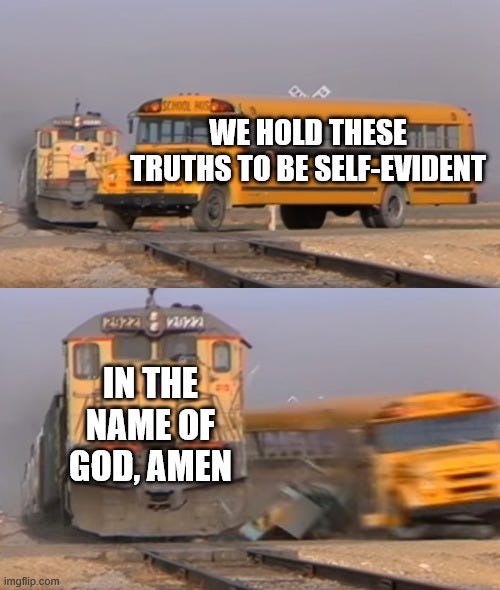
Here, we cannot but see the distance between Mayflower and Philadelphia. “We the People,” the most important words in the United States Constitution, tell us all we need to know: government of, by, and for the People. Everything else in the document (and on this, we may roughly agree with Kendall) is just detailed procedure for our deliberations to frame those just and equal laws. The title deed to the American project, the moral justification for our existence, lies in the appeal made by those first three words: to the consent of the governed, made necessary by the recognition that “all men are created equal.”
And to what, or whom, does Mayflower appeal by contrast? “We, whose names are underwritten?” We, who happen to find ourselves far enough away from King James with enough shot and powder to eradicate opposition? Okay, there’s more than that. “In the name of God, Amen” and “in the Presence of God and one another, covenant and combine ourselves into a civil Body Politick.” God gives them the right! Presumably just as he covenanted with the Israelites? Now, for one, what gives these Puritans the right to claim the inheritance of Israel? Sounds a lot like we’re just polishing force of arms by saying “Jesus” (wasn’t there a Commandment about this?) though to be fair, the Pilgrims aren’t alone in that fraud. And, for another, recall that the Old Testament Covenant left a rather genocidal wake. So, we see that the Mayflower Compact’s claim of right distills to an exclusive (“city upon a hill”) divine favor, to being a community of the Elect (which, as we recall, Kendall will airbrush as the faithful people deliberating under God)—the obvious flip-side being that everyone else, who by the way are not included in this democratic experiment, is damned to hell for all eternity.
The inadequacy of the Mayflower Myth as a moral justification for America is matched only by its threat to the entire venture. Whether the Protestant Congregational tradition embodied by Mayflower gave birth to the flaws of American classical liberalism or merely supercharged those already present, we cannot hope to address here. It is enough to see that latter did in no way displace the former. On the contrary, the Founders’ liberalism appears to have gulped down all its dangers as only a protestant could. What follower of Christ so readily acknowledges “the Duty of Self Preservation”—fear of death, that is—as “the first Law of Nature” (Sam Adams, Rights of the Colonists (1772)) but an adherent of the arbitrary and capricious Old Testament Almighty who isn’t entirely sure of his Election? The only word Paine will forget in Common Sense, describing “government” as a “necessary evil,” “the last punisher” of “our wickedness,” is depravity. And blessed are the poor, whom you shall love “as yourself,” for as Poor Richard tells us—trust not to the care of others, “If you would have your Business done, go; If not, send;” after all, “When the Well’s dry, they know the Worth of Water;” thus, accumulate!, for “God helps them that help themselves”and “there will be sleeping enough in the grave.”
As it turns out, the horseshit stories we tell our kids do matter. Mayflower offers a pretty good starting point for explaining Poor Richard’s Death Drive: a nation of depraved potential murderers driven to ceaseless accumulation just as much by the desperate need for material indicia of God’s favor as by the mortal terror of finding out they are arbitrarily damned to eternal hellfire. Happy first week back, everyone. Have fun asking ChatGPT for help on your calculus homework.