

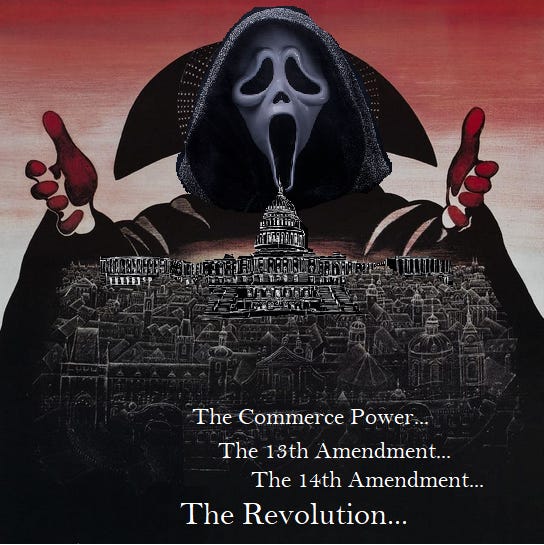
The Right’s present war on the administrative state and Congressional commercial authority more generally reveals a lingering resentment of abolition, and they’re not chasing shadows. Under its original commerce authority, however inchoate, Congress possessed the authority to abolish slavery. The Left has not only forgotten this, but ceded, virtually uncontested, more fundamental ground. Recognizing Congress’ authority to abolish slavery demands an equally vigorous understanding of the Reconstruction Amendments, lest they become superfluous: Congressional authority to define and guarantee, in affirmative contradiction to the substantive shackles of enslavement, the contours of both free personhood and citizenship in the United States. Amidst the Right’s simultaneous war on individual rights, the Left must recognize that The People in Congress have had, at least since 1868, the power to guarantee food, shelter, education, safe working conditions, healthy environment, bodily autonomy, and anything else we might decide American freedom and citizenship should mean. Our failure to do so represents not some long-dead enslavers’ constitutional bindings, but every successive generation’s failure of political and moral will.
A specter haunts Republicans, the specter of Congressional abolition. Far more than just condemning us to the fractured whims of local luminaries, as incapable of tackling climate change as they are policing airspace between crop-dusters, Republicans’ present war on Congressional commerce powers obfuscates both its authority to abolish slavery under the original Constitution and its plenary authority under the Reconstruction Amendments to define and enforce the guarantees of American freedom and citizenship.
Many Republican grievances clearly serve their agenda. They strip women of bodily autonomy, and thus their “ability . . . to participate equally in the economic and social life of the Nation,” because they believe women to be subordinate.[1] They gut voting rights—particularly Black Americans’ voting rights—because they dislike democracy; free and fair elections, after all, infringe States’ “power, dignity, and authority.”[2] They place Republican presidents above the law, preferring the dictate of an “energetic, vigorous, decisive, and speedy,” yet still “sensitive” and “fearless[]” man.[3] They hate unions which would raise wages or, worse, threaten factory and plantation owners’ “sole and despotic dominion” over their property.[4] They gleefully strike gun regulations because this nation’s tradition of mob violence, particularly against people of color,[5] “demands our unqualified deference”[6]—some people ought to be killed![7] They minimize or ignore civil rights legislation to marginalize women, people of color, the disabled, and (most recently) LGBTQ folks.[8] And they perpetuate the lingering effects of chattel slavery, dismissing remedial efforts as incoherent, burdensome to White America, and, ultimately, because they’ve never accepted people of color as their equals.[9]
But the source of Republicans’ general distaste for Congressional power proves more elusive. Just this past term, the Supreme Court gutted Congress’s authority to create causes of action and delegate them to administrative tribunals, like the Securities and Exchange Commission whom Congress tasked with more vigorously rooting out investment fraud following the Great Recession,[10] and, inflamed by commercial fishing regulations, axed administrative agency authority generally.[11] Two years ago, rebuking the hated-Environmental Protection Agency, it slashed Congress’s power to grant authority to those agencies in the first place, if the Court thought the issue too important.[12] And in one highlight of COVID summer, the Court took a bat to the Consumer Financial Protection Bureau to kneecap Congress’ power to insulate certain expert agencies from undue political influence.[13] Before that, the Court nixed Congress’s power to curtail violence against women[14] or limit guns in schools.[15] These last two prove particularly illustrative because rather than simply striking important provisions of the Violence Against Women Act of 1994 for perpetrating an unequal affirmative action preference for women, or the Gun Free School Zones Act of 1990 for infringing disgruntled Americans’ right to liquidate schoolchildren—as one would expect—the Court instead castigated Congress for overstepping its authority to regulate conduct and goods in and about the national economy. “We accordingly reject the argument that Congress may regulate noneconomic, violent criminal conduct based solely on that conduct’s aggregate effect on interstate commerce.”
Naturally, Republicans also reject Congressional authority over economic activity that, on aggregate, substantially impacts interstate commerce. The name Wickard v. Filburn[16] still haunts them. To control wheat prices and supply during the Great Depression, and in the leadup to the Second World War, Congress limited the amount of wheat an individual could grow, even for personal use. Mr. Filburn complained that his personal wheat stores—that is, stores in his barn that have never even left the farm, much less crossed state lines—fell outside of Congress’s authority over interstate commerce. The Court disagreed, reasoning that Congress could regulate not just the channels and instrumentalities of interstate commerce (as it had long been understood to) but also economic activity that (though not interstate in particular) would in aggregate substantially affect interstate commerce. That is, if we all stayed home and grew our own wheat, the wheat market would go bust.
Detractors hardly lack grounds to criticize the Court’s decision. To take just one, penalizing wheat production seems irrational on the verge of world war. One might also easily distinguish the decision as a special case: it was an emergency; the country wallowed in depression; the storm clouds of war loomed; or, in the timbre of conservative grievance: Wallace and FDR’s commies were just tyrannizing the wheat market so they could ship it all to Stalin. Yet in my experience conservatives eschew these arguments and instead focus their anger on the Court’s expansion of “interstate commerce” to include activity that itself does not cross state lines. They genuinely do believe that the Congress overstepped its commerce power.
Amidst other and more glamorous fronts (e.g., white supremacy, misogyny, homophobia, islamophobia, antisemitism) in our kulturkampf,[17] opposition to Congressional commerce power seems a curious hill for conservatives to die on, passions inflamed by regulatory vicissitudes. It becomes all the more curious considering that Republicans enjoy gross overrepresentation—to the point of capture—in both Houses of Congress. Why not wield Congress’s broad commercial authority to reactionary ends? It can’t simply be contempt for democracy, as legislative bodies may serve totalitarian ends. And the six justices’ arrogating authority at their Republican colleagues’ expense don’t lead the movement, they just reflect it. Something more’s afoot.
History answers. Why have reactionaries always abhorred Congress’s expansive power to regulate interstate commerce? Slavery. A Congress possessing broad commerce power can abolish slavery. Our civil rights owe more to Congress’s commercial powers than one might think. Antebellum lawmakers had recognized (or feared!) Congress’s power to abolish slavery in at least an inchoate form. This power, supercharged by the Reconstruction Amendments, would offer Congress great authority to grant and enforce our civil rights.
To start, never discount the lingering emotional trauma of abolition. Conservative law professors still (at least, as of my time in school) refer to Lincoln as a tyrant and to abolition as “a taking”—implying the validity of the pretension to property in human flesh. Having never even come close to resolving the evils of bondage and the resultant wealth, health, and education (and more) disparities between White and Black America, Chief Justice John Roberts complained only two summers ago: “Twenty years [after this Court authorized token affirmative action programs in higher education,] no end is in sight.”[18] From Justice Scalia calling the Voting Rights Act a “racial entitlement[],”[19] or the Chief’s description of affirmative action as “racial preferences,”[20] to Justice Clarence Thomas’ parroting of Thomas Sowell’s exhausted ‘argument’—that affirmative action policies “redistribute individuals among institutions of higher learning, placing some into more competitive institutions than they otherwise would have attended . . . where they are less likely to succeed”[21]—Republicans continue to recast abolition and its enforcement not as the bare minimum human decency required of us but as an undeserved blessing to be repaid, echoing early white views of abolition: “My friend, you was [sic] once a slave. You are now a freedman . . . With treasure and precious blood your freedom has been purchased. Let these sufferings and sacrifices never be forgotten . . . prize your freedom above gold, for it has cost rivers of blood.”[22] And consider 2021’s Cedar Point v. Hassid in which the Court, studiously avoiding mention of the Thirteenth Amendment, ruled that a California regulation providing farmworker union organizers minimum access to a commercial farm infringed the plantation owners property rights.
Second, thanks in part to cramped understandings of the Thirteenth and Fourteenth Amendments, much modern Federal civil rights legislation actually rest on Congress’s commerce and spending powers. Under current law, the Equal Protection Clause doesn’t stop universities from creating or ignoring climates of sexual assault and harassment; loss of Federal funding via Title IX does.[23] Employers can’t harass or fire women or people of color or the elderly not because of some robust understanding of Constitutional rights, but because Congress owns and regulates the interstate commerce in which all that conduct occurs.[24] So too, restaurants, bars, clubs, theaters, hotels, tolls roads, railroads, airlines, businesses open to the public, and all forms of public accommodation can’t deny service on the basis of race or sex or religion not because of the Fourteenth Amendment but because, again, interstate commerce occurs at Congress’ pleasure.[25]
This may seem a crass workaround. Morally, we may protest, racial discrimination in restaurants should be prohibited as a badge and incident of slavery, not because some suits from D.C. successfully argued that Ollie’s Barbecue obtained the ingredients and customers for their crappy racist-white-person barbecue from the local Federal interstate highway. Further digging, however, reveals not a slapdash workaround but a powerful argument for civil rights and equality well founded in the common law.
Take a step back. Why don’t most civil rights provisions rest on the Thirteenth and Fourteenth Amendments’ abolition of slavery and extension of equal citizenship? Much traces to an 1883 group of Supreme Court cases called, aptly enough, The Civil Rights Cases.[26] Alert to the first rounds of Jim Crow laws passed not even ten years after Appomattox, Congress outlawed racial discrimination in public accommodations in the Civil Rights Act of 1875. In a decision of unnecessary length, Justice Joseph P. Bradley struck down these provisions, reasoning that they exceeded Congress’s enforcement powers under either the Thirteenth Amendment—former slaves can’t just call “racism” at each injustice; it’s time for them to pull themselves up by their bootstraps—or the Fourteenth Amendment, which Bradley reported as only prohibiting “State[s]” from infringing one’s rights. Besides, he reasoned, if the Fourteenth Amendment authorized Congressional civil rights legislation, that would violate the Tenth Amendment’s reservation of States’ Rights.
Dissenting alone, Justice John Marshall Harlan (remembered largely for his Plessy v. Ferguson dissent) lambasted the Court. Precisely the same racism animated denial of service as ‘justified’ enslavement—“such discrimination practiced by corporations and individuals in the exercise of their public or quasi-public functions is a badge of servitude”—precisely what the Thirteenth Amendment prohibits.[27] And while Sections 2 and 3 of the Fourteenth Amendment prohibit “State[s]” from infringing one’s due process rights and equal protection of the law, Section 1 extends equal citizenship to all born in the United States. “Citizenship in this country necessarily imports at least an equality of civil rights among citizens of every race . . . .”[28] That citizenship necessarily includes one’s right as a freeperson to travel freely and engage in all sorts of public life—rights explicitly denied to the enslaved. Equal access to public accommodations, Harlan explained, constituted not some special privilege but rather counted among the core bundle of rights of freedom and citizenship.
Crucially, however, Harlan didn’t rest this notion of free-personhood and civil accommodations on some newfangled reading of the Thirteenth or Fourteenth Amendments. He rooted it deep in the common law, surveying how innkeepers (“The innkeeper is not to select his guests.”)[29], ferrymen, and pub[lic house—you see it?] landlords would face liability for denying accommodations to any traveler unless he (the purveyor) lacked capacity (“no room at the inn?”). Commerce is conducted at the sovereign’s pleasure, after all. And our Framers vested that same power, if only over interstate commerce (though, one might struggle to find turnpikes, ferries, railroads truly untethered from the interstate network), in Congress. That is, neither Amendment gave Congress the power to govern civil accommodations. Congress already possessed that power. Recognizing the equal dignity of people of color, women, and other historically marginalized folks in this nation remains crucial to the passage and implementation of civil rights legislation today. But the Commerce Clause justification rests on an equally important foundation: that when one enters (and indeed profits from) civil society, society rules.
Third, then, it should come as no shock that if Congress may govern even denials of commercial interaction incident to its commerce authority, it may also govern—even abolish—the ultimate perversion of commerce: human bondage. True, the Three-Fifths Compromise and the Fugitive Slave Clause very much accommodated the original Constitution of the United States to human enslavement. But do not exculpate the Founders and every antebellum generation for their failure to abolish slavery on the pretext that they placed their hands over their hearts and humbly stripped themselves of that power. The story of Anglo-American constitutional development proclaims the slow but inexorable development of legislative supremacy, as Parliament matured from minor fundraising gatherings for insolvent sovereigns into the sovereign manifest. So too the Founders expected, or feared, Congress to follow.
That Congress never tried to abolish slavery by commercial legislation proves only that it lacked the moral will or political capital to try. Why constrain Congress not to prohibit the slave trade until January 1, 1808 (which, coincidentally, it did) if Congress did not inherently possess the power to do so? Plenary authority over interstate commerce plainly authorized Congress to abolish the domestic slave trade. The Takings Clause hardly guaranteed perpetual property in other human beings. It merely guaranteed just compensation (including none) if the property were to be taken. The First Congress’s Northwest Ordinance prohibited slavery in the Old Northwest; and the Missouri Compromise of 1820—legislation hallowed to the point of near-constitutionality until the near-secession of 1850[30]—prohibited slavery above the southern border of Missouri (Missouri excepted, of course). Calling these mere territorial bills cheapens their practical effect: Congress abolished slavery in Northern States. No wonder the South fought so hard to repeal the Missouri Compromise in the 1854 Kansas-Nebraska Act, even arguing that the Compromise of 1850 had already superseded it.[31]
Finally, consider how the question of Congressional authority animated the blockbuster case of the era. Law professors like to teach the infamous Dred Scott v. Sanford[32] as primarily holding that Black Americans could not be United States (Federal as opposed to State) citizens—the infamous “no rights which the white man was bound to respect” line—calling everything else Chief Justice Taney said about Congress lacking authority to abolish slavery in the territories superfluous dicta. Aside from ignoring courts’ tendency to offer alternative justifications for a result, this view mistakes the facts of the case. Scott’s claim to freedom by reason of travel[33] to free territory (Fort Snelling, outside modern Minneapolis) rested, regardless of the Missouri Compromise’s official repeal, on its continued practical effect: Minnesota remained free territory and would enter the Union as a free state the next year. Damn the man but recognize the reasoning. Ruling only on Mr. Scott’s capacity to sue would leave the law splintered. Territorial claims to freedom would continue to arise. Taney’s procedural ruling would bar Black Americans from Federal court. And he could trust Southern State courts to reject claims to freedom based on travel (Scott had previously lost his claim in Missouri State court). But he could not rely on Northern State courts to do the same. Theoretically, dissatisfied enslavers could seek the Supreme Court’s review of adverse State Court decisions—cold comfort if the State Court had already (and irretrievably) released a plaintiff, rendering any word from Taney hopelessly futile. The issue of Congressional abolition would fester unresolved in the Courts, stoking debate over the issue in Congress. If Taney didn’t decide it in 1857, Congress would.
Yet even with Taney’s decision, how could it not? In 1857 the Supreme Court had yet to seize its modern mantle of Constitutional Arbiter.[34] Not only had President Jackson claimed the authority to differ from the Supreme Court on constitutional matters in vetoing the Bank of the United States—“The authority of the Supreme Court must not, therefore, be permitted to control the Congress or the Executive when acting in their legislative capacities, but to have only such influence as the force of their reasoning may deserve.”[35]—President Lincoln shortly would too, specifically referencing Taney’s decision!—“[T]he candid citizen must confess that if the policy of the Government upon vital questions, affecting the whole people, is to be irrevocably fixed by decision of the Supreme Court . . . the people will have ceased to be their own rulers.”[36] Congress surely would decide the matter.
In a pleasing irony, Taney’s attempt enlivened the very point he sought to bury. His hubris, inconceivable only years before—that not just the 1820 but the First Congress of men who drafted the Constitution overstepped—had only become politically feasible by the repeal of the quasi-constitutional Missouri Compromise and the antipathy to slavery’s expansion it represented. Loosed by a coalition of men who believed either in the positive good of enslavement or, like Senator Stephen A. Douglas, preached moral indifference under the guise of popular sovereignty, “a Constitution interpreted by judges of Taney’s persuasion might mean anything the interests of the slave power required it to mean.”[37] Lincoln recognized well the art of the possible in politics. As he later hammered Douglas, Taney’s first step (on Douglas’ foundation) burst the door wide to the next: a declaration that States, too, lacked the power to abolish slavery within their jurisdiction.[38] But sauce for the goose, Mr. Saavik . . . . On the rock of a renewed moral condemnation—“I tremble for my country when I reflect that God is just”[39]—Congress’ unquestioned power over the import and interstate dealings, and over the channels of interstate (and international) commerce that permeated the South, breathing life into the institution of chattel enslavement,[40] Douglas’ stunning political reinterpretation of the Constitution to enslaver’s ends may just as easily have bent toward abolition. True, Lincoln professed in public his belief that Congress lacked the authority to abolish slavery. Though, for one, as a politician he made all sorts of rhetorical concessions to win votes[41] (or to avoid civil war), and, for another, he then proceeded to initiate Southern abolition by executive order. Confirming the matter, the South seceded as soon as the anti-slavery Republican party proved capable of winning both Houses of Congress and the Presidency. In a Congress composed of antislavery men, abolition was merely a matter of time.
Republican resentment of Congressional commerce power may be a centuries-long temper tantrum, but we cannot call it fantasy. A fulsome commerce power would authorize not just Congressional abolition, but most of the ‘overbearing’ administrative that state conservative voters (and landowners) fear. Federal airspace lies above all land. All water flows downhill into the navigable waters of the United States. All pollution eschews state boundaries. All employment conditions, wages, hours, and benefits, ripple at least across a regional economy crisscrossed by interstate highways and often enough across state lines. Interstate conduct and conduct that substantially affects the national economy be damned! Federal authority permeates our daily lives and employ which necessarily rely on the bounty not just of interstate but international commerce—the core of the commerce power. If twenty-five hundred years of political theory have taught us anything, we should tread carefully around such expansive powers, whether wielded for good or for ill. Though, that’s no argument not to use them.
Moreover, intended or not, fear of Congressional commerce authority obscures a greater and untapped power. Under a mature understanding of the Commerce Clause, the Thirteenth Amendment no more ‘grants’ Congress the authority to abolish slavery than it makes human bondage wrong in the first place. Instead, it grants Congress plenary authority to root out and shatter the substantive shackles of human bondage—those rights and privileges of freepersons specifically denied to the enslaved—wherever they may be found. That is, the Amendment vests in Congress the authority to define and guarantee the contours of free personhood. So too the Fourteenth Amendment no more grants Congress the power to provide for equal accommodations in interstate commerce than it makes Americans of color equal. Rather it grants Congress plenary authority to delineate and enforce the contours of United States citizenship in all contexts. After all, Congress explicitly drafted the Amendment to confirm just that: its legislation of citizens’ rights to travel, sue, give testimony, contract, and transact real property in the Civil Rights Act of 1866. The Supreme Court’s early hesitation and ultimate hostility to this power, from 1872’s Slaughterhouse Cases[42] to City of Boerne v. Flores[43]—1966’s Katzenbach v. Morgan[44] a telling exception—merely illustrates pervasive reactionary (read, white supremacist) strains in American law alongside liberals’ cherished tendency to cede ground uncontested.
Indeed, Republicans’ stalwart resistance to Congress’ commerce powers marks a defense of forward ground. For if liberals were to recognize the true power of Congress’ commerce powers, so too they might discover the true potential of the Reconstruction Amendments. Thus Republicans fire recklessly at disfavored agencies like the Consumer Financial Protection Bureau or the Environmental Protection Agency with arguments that would also destroy the Federal Aviation Administration or the Federal Reserve.[45] They wield property rights against union organization, against decades of precedent and the Thirteenth Amendment.[46] And they have begun to fashion religion as a trump card over basic civil accommodations.[47] If anything, Republicans appear to be advancing.
It’s easy to despair, dismissing the Constitution as irretrievably an enslaver’s document. Yet it bears repeating: abandoning the Constitution to the Right unnecessarily absolves every postbellum generation—including our own—for their failure to effectively abolish slavery and guarantee the blessings of American freedom and citizenship. If the forces of reaction want our Constitution so, let them come and take it. Our hands are not tied. Never let the want of perfect tools prevent use of effective ones, and we have been handed effective tools. The Constitution as it has existed since 1868 has authorized Congress to do all of this. Our failure to do so represents not some long-dead enslavers’ constitutional bindings, but every successive generation’s failure of political and moral will.
But look on the bright side. Congress has always possessed the (however inchoate) power to abolish slavery. It always had the power to govern conduct in large swathes of the public sphere to enforce that abolition. The Thirteenth and Fourteenth Amendments supplanted the original primacy of the States and named Congress the primary expositor and guarantor of both the contours of freedom and citizenship in this country. This mature notion of Congressional authority asks not merely whether Congress may regulate incident to interstate commerce or funding. Rather, it first asks us to define freedom by affirmatively breaking the substantive shackles that once defined bondage. And, more powerfully, it asks what we can imagine freedom and citizenship in the United States of America should mean. The Reconstruction Amendments charge Congress to guarantee at least American’s access to food, shelter, education, clean drinking water, safe working conditions, gun safety regulations, bodily autonomy, and much more. In other words, Republicans should fear Congress. A specter indeed haunts.
[1] Dobbs v. Jackson Women’s Health, 597 U.S. __, op. at 64–65 (2022).
[2] Shelby County v. Holder, 570 U.S. 529, 544 (2013).
[3] Trump v. United States, 603 U.S. __, op. at 6–11 (2024).
[4] Cedar Point v. Hassid, 594 U.S. __, op. at 7 (2021).
[5] Carol Anderson, The Second (2021); Dave Davies, Nat’l Pub. Radio, Historian Uncovers the Racist Roots of the 2nd Amendment (June 2, 2021) (“In that, the Second Amendment really provided the cover, the assurances that Patrick Henry and George Mason needed that the militias would not be controlled by the federal government, but that they would be controlled by the states and at the beck and call of the states to be able to put down these [slave] uprisings.”).
[6] NY State Rifle & Pistol Ass. v. Bruen, 597 U.S. __ (2022). See also, Garland v. Cargill, 602 U.S. __v (2024).
[7] Greg Sargent, The New Republic, MAGA Gov Candidate’s Ugly, Hateful Rant: “Some Folks Need Killing!” (July 5, 2024). Or consider Justice Samuel Alito’s formulation: “Why, for example, does the dissent think it is relevant to recount the mass shootings that have occurred in recent years . . . [t]he New York law at issue in this case obviously did not stop that perpetrator.”). Bruen, concurrence at 2.
[8] 303 Creative v. Elenis, 600 U.S. __ (2023); Our Lady of Guadalupe Sch. v. Morrissey-Berru, 591 U.S. __ (2020); Comcast v. Nat’l Ass’n of African American-Owned Media, 589 U.S. __ (2020); Hosanna-Tabor Evan. Luth. Church & Sch. v. EEOC, 565 U.S. 171 (2012).
[9] Students for Fair Admissions v. Harvard, 600 U.S. __, op. at 22–23 (labeling remedy incoherent), 27 (college admissions as zero-sum) (2023); Parents Involved in Comm’ty Schls. v. Seattle Sch. Dist. No. 1, 551 U.S. 701 (2007).
[10] SEC v. Jarkesy, 603 U.S. __ (2024).
[11] Loper Bright Enters. v. Raimondo, 603 U.S. __ (2024).
[12] West Virg. v. EPA, 597 U.S. __ (2022).
[13] Seila Law LLC v. CFPB, 591 U.S. __ (2020).
[14] United States v. Morrison, 529 U.S. 598, 617 (1999).
[15] United States v. Lopez, 514 U.S. 549 (1995).
[16] 317 U.S. 111 (1942).
[17] Romer v. Evans, 517 U.S. 620, 636 (1996) (Scalia, dissenting).
[18] SFFA at 22.
[19] Shelby County v. Holder, Tr. at 47:9 (Feb. 27, 2013).
[20] SFFA at 23.
[21] Id. at 39–40.
[22] Saidiya Hartman, Scenes of Subjection 130 (1997).
[23] Education Amendments of 1972, Pub. L. 92-318, 86 Stat. 235, 373 § 901 (June 23, 1972); Jackson v. Birmingham Bd. of Ed., 544 U.S. 167, 173, 181–82 (2005) (When Congress enacts legislation under its spending power, that legislation is in the nature of a contract: in return for federal funds, the States agree to comply with federally imposed conditions.”) (cleaned up).
[24] Civil Rights Act of 1964, Title VII, Pub. L. 88-352, 78 Stat. 241, 253, § 701 (“The term “employer” means a person engaged in an industry affecting commerce . . . .”); Regents of Univ. of Cal. v. Bakke, 438 U.S. 265, 367 (1978) (Brennan, J., concurring in part and dissenting in part) (“Title VII was enacted pursuant to Congress’ power under the Commerce Clause.”).
[25] Katzenbach v. McClung, 379 U.S. 294 (1964); Heart of Atlanta Motel v. United States, 379 U.S. 241 (1964).
[26] 109 U.S. 3 (1883).
[27] Id. at 43.
[28] Id. at 48.
[29] Id. at 41.
[30] Harry V. Jaffa, Crisis of the House Divided 284 (Chi. ed. 1982)
[31] Id., chs. V–VIII.
[32] 60 U.S. (19 How.) 393 (1857).
[33] No mere technicality, this argument articulates the principle that a state governs its own jurisdiction, that is, its own soil, generally to the exclusion of other states. Indeed, in 1772, the King’s Bench freed one Mr. Somerset, who “had been a slave to Mr. Stewart, in Virginia,” and “had been brought over to England by his master . . . The question on that [being] not whether slavery is lawful in the colonies . . . but whether in England?” Somerset v. Stewart, 98 E.R. 499, 12 Geo. 3 (K.B. 1772).
[34] Cooper v. Aaron, 358 U.S. 1, 18 (1958) (“[T]he interpretation of the Fourteenth Amendment enunciated by this Court in [Brown v. Board of Education] is the supreme law of the land.”).
[35] Andrew Jackson, Message to Congress (July 10, 1832).
[36] Abraham Lincoln, First Inaugural Address (Gilder Lehrman Collection, March 4, 1861).
[37] Jaffa at 293.
[38] Jaffa at 284–89.
[39] Thomas Jefferson, Notes on the State of Virginia, Query XVIII in The Portable Thomas Jefferson (Merrill D. Peterson, ed. 1975).
[40] Matthew Spooner, Ph.D. dissertation, Origins of the Old South: Revolution, Slavery, & Changes in Southern Society (Col. Univ. 2015), at 14 (“[T]he most important factor limiting the inward spread of slavery was the interior’s lack of access to the global market.”), at 232–33 (“[S]outherners threw money and slaves into clearing unusable land, digging canals, and opening new roads and waterways to bring bulky slave-produced goods to the ocean.”).
[41] Consider his public remarks against interracial marriage while arguing against racial chattel enslavement to white supremacist Illinoisians via a race-neutral syllogism: “As I would not be a slave, so I would not be a master.” Id. at 306.
[42] 83 U.S. (16 Wall.) 36 (1873).
[43] 521 U.S. 507 (1997).
[44] 384 U.S. 641 (1965).
[45] Seila, West Virginia, and Loper Bright.
[46] Cedar Point.
[47] 303 Creative.